Before the First Fire: A Homeowner's Chimney and Fireplace Prep Guide
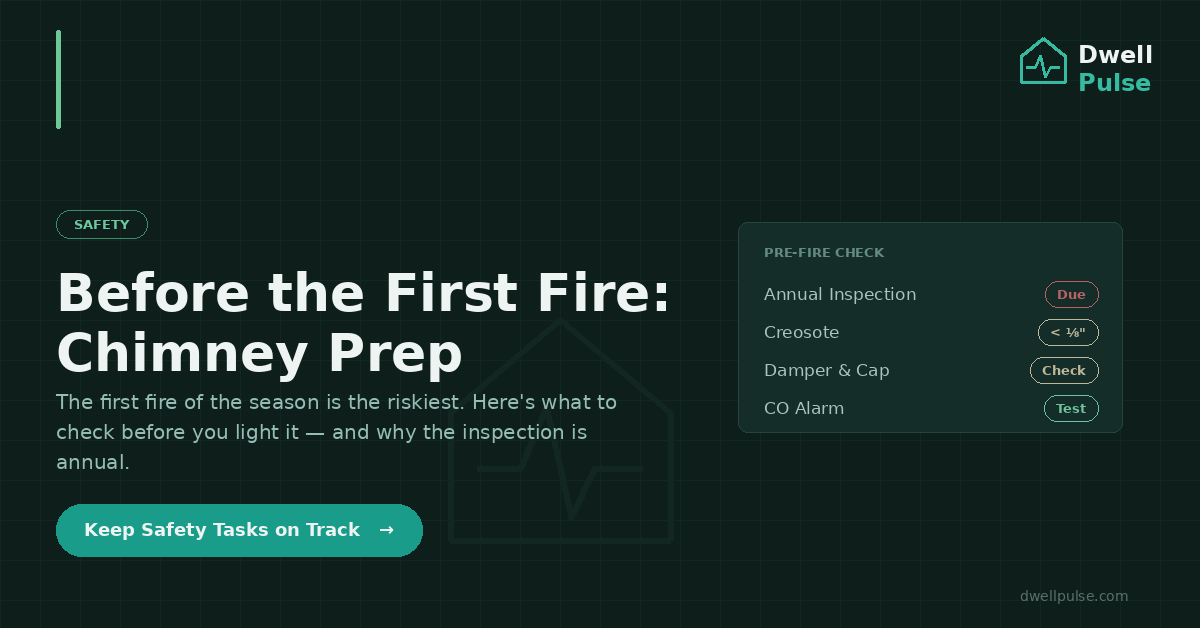
The first fire of the season feels like the coziest thing in the world. It’s also statistically the riskiest one you’ll light all year — because whatever built up in your chimney last winter has been sitting there untouched for months. Before you strike that match, there’s a short list worth running.
This isn’t fussiness. Home heating equipment causes an average of 48,530 home fires a year, with about 500 deaths, 1,350 injuries, and $1.1 billion in property damage — and nearly half of them happen in December, January, and February, with January alone accounting for 20% [1]. A chimney fire can reach up to 2,000°F, hot enough to crack the flue and spread into the house framing [2]. The prep below is cheap insurance against being one of those numbers.
Why a Chimney Needs Looking At Every Year
The culprit is creosote — a flammable, tar-like residue that wood smoke leaves on the inside of your flue [2]. It builds up a little every fire, and it is genuinely dangerous stuff: liquid creosote can flash at temperatures as low as 165°F, and dry creosote self-ignites around 451°F [1]. A flue lined with it is a fuel load waiting for a stray spark.
That’s why both the NFPA and the Chimney Safety Institute of America (CSIA) recommend an inspection every year, before the heating season [2]. The inspection is the non-negotiable part. Cleaning only happens if it’s needed — more on that below.
What the Three Inspection Levels Mean
Chimney inspections come in three levels under the NFPA standard. Knowing which one you need keeps you from overpaying — or under-checking [2]:
| Level | What it covers | When you need it |
|---|---|---|
| Level 1 | Visual check of readily accessible interior and exterior parts | Your annual inspection, if nothing’s changed and the chimney’s in good shape |
| Level 2 | A more thorough look at accessible flue and chimney sections (often with a camera) | After a system change, a malfunction, a chimney fire, a storm or earthquake — or when buying or selling a home |
| Level 3 | Comprehensive, including hidden/concealed parts (may require removing components) | When a serious hidden hazard is suspected |
For most homeowners running the same fireplace they ran last year, a Level 1 is the annual baseline. The Level 2 is worth flagging: it’s the one that applies at a home sale — a point too many buyers and sellers skip right past.
The Pre-First-Fire Checklist
Even with a pro inspection booked, here’s what to walk through yourself before lighting up:
- Confirm this year’s inspection is done. If you haven’t had it yet, book it now — sweeps get slammed once the cold hits, and you don’t want to wait until January.
- Check the damper. It should open and close fully and smoothly. A stuck-shut damper fills the room with smoke; a stuck-open one is a chimney-sized hole in your house all winter.
- Look for creosote. If you can see a shiny or flaky black buildup thicker than ⅛ inch on the flue walls, stop — it needs cleaning before any fire [2].
- Inspect the chimney cap and crown from the ground. A missing or damaged cap lets in rain, animals, and leaves — all of which cause blockages and moisture damage.
- Clear the area. Nothing combustible within three feet of the firebox — rugs, furniture, decorations, stockings.
- Test your smoke and CO alarms. Any fuel-burning appliance can produce carbon monoxide if it’s not venting properly, so working CO alarms aren’t optional [1]. Test them, and replace batteries now. (A good habit: tie it to the clock change at the start of November.)
- Burn the right wood. Only seasoned, dry hardwood — wet or green wood and softwoods like pine produce far more creosote, far faster [2].
Clean vs. Inspect: They’re Not the Same Thing
This trips people up. The inspection is annual, every year, no exceptions. The cleaning happens only when there’s enough buildup to warrant it — specifically, once creosote passes that ⅛-inch threshold [2].
How fast you hit that threshold depends on how you burn. If you use the fireplace more than about three times a week through the season, or you burn softwoods, you’ll likely need cleaning more than once a year [2]. A light user burning well-seasoned hardwood might go a full year between cleanings. The annual inspection is what tells you which camp you’re in.
Gas Fireplaces Need This Too
If you’ve got a gas or oil-fired fireplace or insert and think you’re off the hook — you’re not. The CSIA recommends annual inspections for gas appliances as well [2]. They won’t build creosote, but vents clog, components fail, and a blocked or cracked vent is exactly how carbon monoxide ends up indoors instead of outside. The cleaning may not be needed yearly, but the inspection is.
What It Costs
The numbers are reassuringly small against the risk [2]:
- Standard cleaning + inspection: roughly $129–$380
- Level 1 inspection: typically under $200
- Level 3 inspection: up to $5,000 (rare — only when a serious hidden problem is being chased down)
Put that next to $1.1 billion in annual heating-fire damage and the math makes itself. This is the cheapest line item in your whole heating season.
Why Keeping the Record Matters
Chimney care is a once-a-year task that’s easy to let slide — until you’re lighting the first fire in December and realizing you never booked the sweep. And because the Level 2 inspection matters specifically at a home sale, the household that kept its inspection records has something a buyer actually values: proof the chimney’s been cared for, not just a verbal “oh yeah, we had it looked at.”
How DwellPulse Helps
DwellPulse keeps the annual chimney check from slipping to the bottom of the list. Set a recurring early-fall reminder so the inspection gets booked before the sweeps are backed up and before the first cold night — not after. Log each inspection and cleaning with the date and who did it, and keep the sweep’s report in your document vault, so the record is there when you need it — including at sale time, when a documented chimney history is exactly the kind of transparency a buyer rewards. A safe first fire is mostly about not forgetting the step that comes before it — and that’s precisely what DwellPulse is built to handle.
Keep your seasonal safety tasks on track →
Sources: [1] J.S. Held, “Fireplace & Chimney Fire Damage: Causes, Liability, Recalls & Safety,” citing NFPA heating-equipment statistics — an annual average of 48,530 home heating fires (2014–2018) causing ~500 deaths, 1,350 injuries, and $1.1 billion in property damage; 48% occurring in Dec–Feb (January 20%); creosote flash point as low as 165°F and dry auto-ignition ~451°F; and guidance to vent fuel-burning equipment outdoors and test CO alarms. [2] This Old House, “How & When To Clean Your Chimney Depending On Your Fireplace,” on the NFPA/CSIA annual-inspection recommendation (wood and gas), the ⅛-inch creosote cleaning threshold, the NFPA inspection Levels 1/2/3 and when each applies (including Level 2 at a home sale), chimney fires reaching up to 2,000°F (CSIA), and cost ranges ($129–$380 standard cleaning/inspection; Level 1 under $200; Level 3 up to $5,000, via Angi).
* This article was written with the assistance of AI tools. All content is reviewed and edited by Josh Standeven.
Ready to take control of your home?
DwellPulse is free to start — track maintenance, projects, appliances, and your garden all in one place.
Start Free Today →