Composting and Soil Health: The Foundation Every Good Garden Is Built On
Every experienced gardener will eventually tell you the same thing: you don’t grow plants, you grow soil. Feed the soil, and the soil feeds the plants. Neglect it, and no amount of watering, fertilizer, or hopeful replanting will fix a garden that’s struggling from the ground up.
The good news is that improving your soil is one of the most achievable things in gardening, and the primary tool is free: compost. Here’s what compost actually does, how to make it, how much to use, and how to know what your soil really needs.
Why Soil Health Matters More Than Anything Else
Soil isn’t just dirt that holds plants up. Healthy soil is a living ecosystem — a web of microorganisms, fungi, and organic matter that stores water, delivers nutrients, and gives roots the structure they need to grow. The USDA defines soil health as the continued capacity of soil to function as a vital living ecosystem [1].
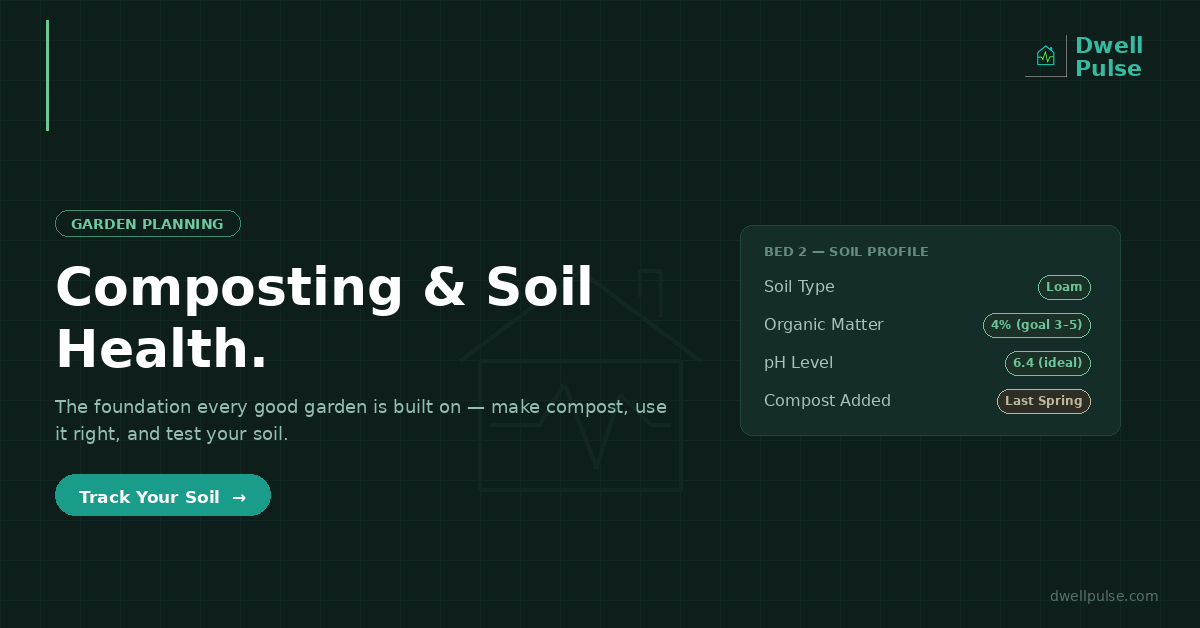
The single most important measure of that health for a home gardener is organic matter content. Most garden plants perform best when soil organic matter is at least 2%, and the goal for vegetable and flower beds is 5% to 10% [2]. Colorado State University Extension recommends building organic content to 3–5% over a period of years, a level at which the soil begins producing its own nitrogen through a natural process called mineralization [3]. Get organic matter into that range and much of the rest of gardening gets easier.
What Compost Actually Does for Your Soil
Compost is partially decomposed organic matter, and its greatest value isn’t as a fertilizer — it’s as a soil amendment that fundamentally improves how your soil behaves [4]. According to university extension research, compost:
- Fixes heavy clay soil by binding fine particles into larger “crumbs,” which improves aeration, root penetration, and water infiltration, and reduces surface crusting [4].
- Fixes sandy soil by dramatically improving its ability to hold water and nutrients that would otherwise drain straight through [4].
- Feeds soil life. Organic matter is the food source for the microorganisms at the base of the soil food web. Those organisms slowly release nutrients into a form plants can absorb [3].
- Improves soil structure by promoting the aggregation of soil particles, increasing porosity and water infiltration over time, and making soil more resistant to erosion [1].
The remarkable thing about compost is that it improves both problems — clay that drains too slowly and sand that drains too fast — because it’s not correcting the mineral content, it’s improving the structure. The EPA’s 2025 report on compost confirms it improves the physical, chemical, and biological characteristics of soil all at once [1].
How to Make Compost (The Simple Version)
Composting sounds technical but comes down to balancing two ingredients: “greens” and “browns.”
- Greens (nitrogen-rich): fresh grass clippings, vegetable and fruit scraps, coffee grounds, plant trimmings. These break down fast and feed the microbes.
- Browns (carbon-rich): dry leaves, straw, shredded cardboard, wood chips, paper. These provide structure and airflow.
A rough target is 2 to 3 parts browns to 1 part greens by volume. Too many greens and the pile turns slimy and smells; too many browns and it breaks down slowly. Keep the pile about as moist as a wrung-out sponge (extension guidance puts the ideal at 40–60% moisture), turn it occasionally to add air, and nature does the rest [5].
What to leave out: meat, dairy, oils, pet waste, and diseased plants — they attract pests, create odor, or spread problems. Stick to plant scraps and yard waste and you’ll avoid nearly every composting headache.
A backyard pile with minimal maintenance typically takes about 12 months to produce finished compost; turning it regularly and keeping the balance right speeds that up considerably [5]. You’ll know it’s done when it’s dark, crumbly, and smells like earth rather than like the things you put in.
How Much Compost Should You Use?
More is not always better. The widely cited guideline is a compost-to-soil ratio of 20–30% by volume for established beds, rising to 30–50% for brand-new raised beds you’re filling from scratch [6].
The key technique: mix compost into the top 6 to 8 inches of soil rather than leaving it in a layer on the surface. Extension guidance is specific here — compost left in chunks or as a surface layer interferes with root growth and water movement, especially in clay soils, and can lead to shallow rooting [3]. Work it in.
For established beds, an annual 1 to 2 inch top layer worked into the soil each season maintains organic matter as it naturally depletes. One important note: fresh or yard-trimmings compost can temporarily increase your soil’s nitrogen needs for the first couple of months as it finishes decomposing, so well-finished compost is better for immediate planting [7].
Stop Guessing: Test Your Soil
Here’s the step most gardeners skip, and it’s the one that saves the most wasted effort. Before you dump amendments on a struggling garden, find out what it actually needs. A basic soil test from your state’s cooperative extension service typically covers pH, nitrogen, phosphorus, potassium, and organic matter percentage — usually for around $15–25 [6].
That test tells you whether your soil needs more compost, a pH correction (lime to raise pH, sulfur to lower it), a specific nutrient, or nothing at all. It replaces guesswork with a plan. Testing every 2 to 3 seasons catches the slow nutrient drift that quietly undermines gardens over time [6].
Soil pH matters more than most beginners realize: most vegetables prefer a slightly acidic to neutral range of about 6.0 to 7.0, and when pH drifts too far in either direction, nutrients become chemically “locked up” and unavailable to plants no matter how much fertilizer you add.
Why Tracking Your Soil Pays Off
Soil improvement is a multi-year project, and that’s exactly why it’s so easy to lose the thread. Which bed did you amend last spring? What did the soil test say about the bed by the fence? Did you add lime to the tomato bed or the pepper bed? Building organic matter to that 3–5% target happens over seasons, and you can’t manage what you don’t remember.
The gardeners who steadily improve their soil are the ones who keep records — what each bed’s soil is like, what they’ve added, what the last test showed, and how each bed has performed since. That history is what turns random amendment into a deliberate, improving system.
How DwellPulse Helps
DwellPulse tracks your garden at the individual bed level — including each bed’s soil type, depth, and the details that shape what grows well there. Record what you’ve amended and when, keep your soil-test results with the bed they belong to, and track how each bed performs season over season through its planting and harvest history. Because the plant database includes each crop’s preferred soil type and pH range, you can match the right plants to the right beds instead of fighting your soil. Healthy soil is a long game — and DwellPulse gives you the memory to play it well, so every season builds on the last instead of starting from scratch.
Track your garden from the soil up →
Sources: [1] U.S. EPA, “Benefits of Using Compost,” May 2026, drawing on the EPA report “Environmental Value of Applying Compost” (2025), and the USDA NRCS definition of soil health. [2] University of Maryland Extension, “Organic Matter and Soil Amendments,” on the 2% minimum and 5–10% goal for vegetable and flower beds. [3] Colorado State University Extension, “Using Compost in Colorado Gardens,” February 2026, and CMG GardenNotes #711, on the 3–5% organic matter target, mineralization, and mixing compost into the top 6–8 inches. [4] University of Missouri Extension, “Making and Using Compost” (G6956), on compost improving clay and sandy soils and functioning as a soil amendment rather than a fertilizer. [5] Oregon State University Extension, “Improving Garden Soils with Organic Matter,” April 2026, on moisture content (40–60%), yard-trimmings compost, and the ~12-month backyard timeline. [6] Garden Truth, “Compost to Soil Ratio,” May 2026, on the 20–30% (established) and 30–50% (new raised bed) ratios and cooperative-extension soil testing ($15–25). [7] Oregon State University Extension, on fresh/yard-trimmings compost temporarily increasing nitrogen requirements after application.
* This article was written with the assistance of AI tools. All content is reviewed and edited by Josh Standeven.
Ready to take control of your home?
DwellPulse is free to start — track maintenance, projects, appliances, and your garden all in one place.
Start Free Today →