Crop Rotation for Small Gardens: Why Planting Tomatoes in the Same Bed Every Year Is Costing You
You grew tomatoes in the back-left bed last year. They did great. So this year you planted tomatoes in the same spot. They did okay. Next year you’ll do it again — and wonder why your tomatoes suddenly have early blight, stunted roots, and half the yield they used to produce.
This is the most common and most preventable mistake in backyard vegetable gardening. Planting the same crop family in the same soil year after year creates a cycle of increasing disease pressure, nutrient depletion, and declining yields — and the fix is a practice that farmers have used for thousands of years.
What Crop Rotation Actually Does
Crop rotation is the practice of changing what you grow in a given bed or plot each season, following a planned sequence that groups plants by family and nutrient needs. The benefits are well documented.
Breaks disease cycles. Many vegetable diseases are caused by soil-borne pathogens that overwinter in the ground and attack the same plant family the following season. Research shows that proper crop rotation can reduce soil-borne diseases by up to 90% [1]. USDA research specifically found that rotating solanaceous crops (tomatoes, peppers, eggplant) on a three-year cycle reduced bacterial spot incidence by 67% [1].
Improves yields. Studies indicate that rotating crops produces 10 to 25% greater yields compared to planting the same crop continuously [2]. Research on diverse rotations has shown yield increases of up to 48% in some systems [3].
Manages soil fertility naturally. Different plant families draw different nutrients from the soil. Tomatoes and corn are heavy nitrogen feeders. Beans and peas are nitrogen fixers — they put nitrogen back into the soil through their root nodules. Rotating a heavy feeder after a nitrogen fixer takes advantage of the fertility the previous crop built, reducing the need for synthetic fertilizer [4].
Reduces pest pressure. Many insect pests overwinter in soil near their host plants. Moving the host to a different location the following season means the emerging pest has to travel to find food — and in a garden setting, even moving a crop 10 to 15 feet can reduce pest pressure significantly [1].
The Four Plant Families That Matter Most
You don’t need to memorize botanical taxonomy. For backyard rotation purposes, you need to know four groups.
- Solanaceae (nightshades). Tomatoes, peppers, eggplant, and potatoes. This family is the most disease-prone in home gardens. Early blight, late blight, bacterial spot, fusarium wilt, and verticillium wilt all persist in soil and attack any nightshade planted in the same spot. Rotate nightshades on a minimum three-year cycle — ideally four.
- Fabaceae (legumes). Beans, peas, and lentils. These are the nitrogen fixers. Their root nodules host Rhizobium bacteria that convert atmospheric nitrogen into plant-available form. Plant legumes before heavy feeders to naturally enrich the soil. After harvest, cut the plants at ground level and leave the roots in place — the nitrogen is in the root nodules.
- Brassicaceae (brassicas). Broccoli, cauliflower, cabbage, kale, Brussels sprouts, radishes, turnips, and arugula. This family is susceptible to clubroot, black rot, and downy mildew — all soil-borne. Brassicas are also moderate-to-heavy feeders. Rotate on a three-year minimum.
- Cucurbitaceae (cucurbits). Cucumbers, squash, zucchini, melons, and pumpkins. Susceptible to powdery mildew, downy mildew, and cucumber beetles. Moderate feeders. Rotate on a two- to three-year cycle. Everything else — lettuce, spinach, carrots, onions, garlic, herbs — can be treated as fill crops that rotate more flexibly.
A Simple 4-Bed Rotation Plan
The classic rotation for home gardens uses four beds and a four-year cycle. Each bed follows the same sequence, staggered by one year.
Year 1: Bed A gets nightshades (tomatoes, peppers). Bed B gets legumes (beans, peas). Bed C gets brassicas (broccoli, kale). Bed D gets cucurbits (squash, cucumbers).
Year 2: Everything shifts one bed. Bed A gets legumes (following the nightshades to restore nitrogen). Bed B gets brassicas. Bed C gets cucurbits. Bed D gets nightshades.
Year 3: Shift again. Bed A gets brassicas. Bed B gets cucurbits. Bed C gets nightshades. Bed D gets legumes.
Year 4: One more shift. Bed A gets cucurbits. Bed B gets nightshades. Bed C gets legumes. Bed D gets brassicas.
After year 4, the cycle repeats. No plant family occupies the same bed more than once every four years.
What If You Only Have 2 or 3 Beds?
Most backyard gardeners don’t have four beds. The principle still applies — you just adapt.
With 3 beds: Run a three-year rotation. Combine cucurbits with brassicas in one group (they share fewer diseases), and keep nightshades and legumes as their own groups. The cycle is: nightshades → legumes → brassicas/cucurbits → repeat.
With 2 beds: Alternate between heavy feeders (nightshades, brassicas) and light feeders / nitrogen fixers (legumes, root vegetables). Plant a cover crop of crimson clover or winter rye in the off-season to add nitrogen and organic matter. Even this simple alternation is dramatically better than no rotation at all.
With 1 bed: You can still rotate within the bed by dividing it into quadrants and shifting plant families through the quadrants each season. A 4×8 bed divided into four 2×4 sections functions as a miniature four-bed rotation system.
Iowa State University Extension specifically recommends building three or four raised beds as the most straightforward way to implement rotation in a home garden, because each bed creates a physical barrier between growing areas [5].
The Record-Keeping Problem
Here’s where most gardeners abandon the plan. Rotation only works if you remember what was planted where, when. In Year 1, you remember everything. By Year 3, you’re guessing. By Year 4, you’ve forgotten entirely and you plant tomatoes in the nightshade bed again because that’s “the tomato bed.”
Gardening forums and extension services consistently identify “forgetting the plan” as the number one reason home gardeners fail at crop rotation [6]. The solution isn’t a better memory. It’s a record that outlives your memory.
You need, at minimum: what plant family went in each bed, what season it was planted, and what year. Ideally you also track variety, yield, and any disease problems — because that information makes your rotation smarter over time. If Bed C had early blight on tomatoes in 2024, you want to keep nightshades out of Bed C for at least four years, not three.
How DwellPulse Helps
DwellPulse’s garden module solves the record-keeping problem at the architectural level. Every bed has a Crop Rotation Panel that shows what plant families have been grown in that bed and when — so you can instantly see whether it’s safe to plant nightshades there this year or whether you need to wait another season.
The Bed History Panel preserves every crop you’ve ever grown in that bed, even after you “clean out” a finished crop at the end of the season. When you retire a crop, it stays in the bed’s historical record with its planting date, harvest date, yield, and any notes — so next spring you’re planning from data, not memory.
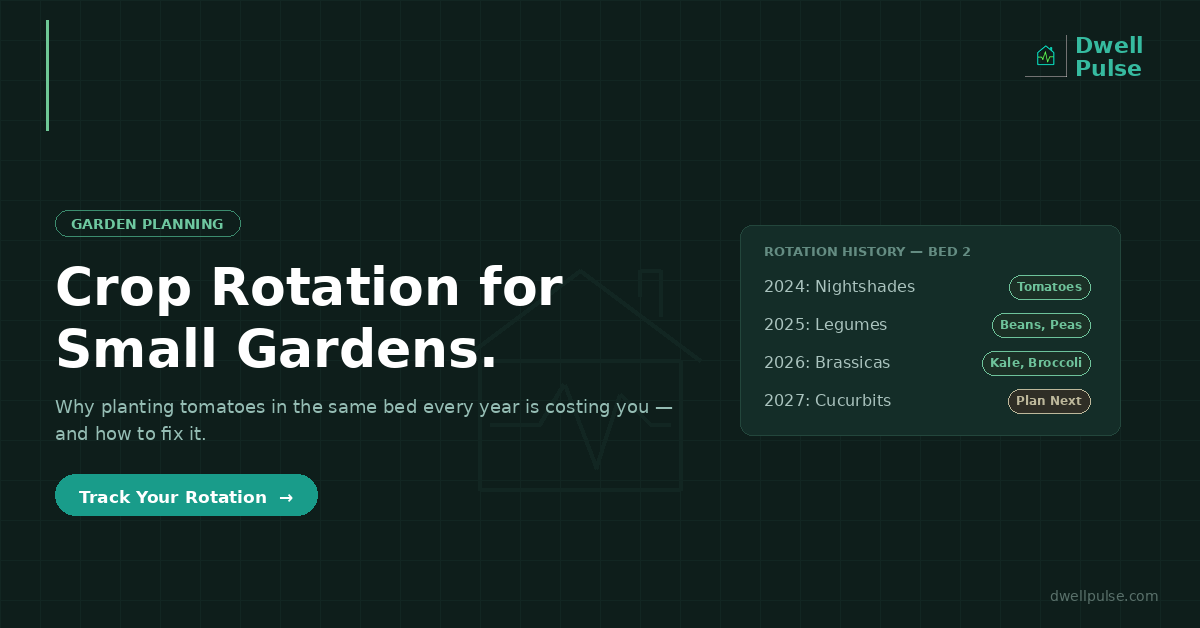
Each planted crop tracks its plant family automatically from the built-in plant database. When the Crop Rotation Panel shows that Bed 2 had nightshades last season and legumes the season before, you know exactly where you are in the cycle without pulling out a journal or trying to remember what you grew two Julys ago.
Pair this with the AI Garden Planner, which factors in rotation history when suggesting what to plant, and the Companion Planting Panel, which flags incompatible neighbors — and your rotation plan builds itself season over season.
Start tracking your crop rotation →
Sources: [1] Thrive Lot, “5 Crop Rotation Tips to Prevent Plant Diseases,” February 2025, citing USDA research on solanaceous crop rotation reducing bacterial spot by 67%, and crop rotation reducing soil-borne diseases by up to 90% and pathogens by 40–60%. [2] Homestead and Chill, “How to Practice Crop Rotation,” August 2023, citing research showing 10–25% yield increases with rotation vs. monoculture. [3] Thrive Lot, “How Crop Rotation Boosts Vegetable Yields,” February 2025, citing studies showing 27–48% higher yields with diverse rotations. [4] The Garden Professors, “Crop Rotation Makes the Garden Go Round,” citing nutrient imbalance research in raised beds. [5] Iowa State University Extension, “Crop Rotation in the Vegetable Garden,” June 2025. [6] Compost Check, “The Importance of Crop Rotation in Raised Bed Gardening,” March 2024, identifying record-keeping failure as a primary barrier.
*Writing assisted by AI
Ready to take control of your home?
DwellPulse is free to start — track maintenance, projects, appliances, and your garden all in one place.
Start Free Today →