Deck and Fence Care: When to Stain, How Often, and the Water Test That Tells You
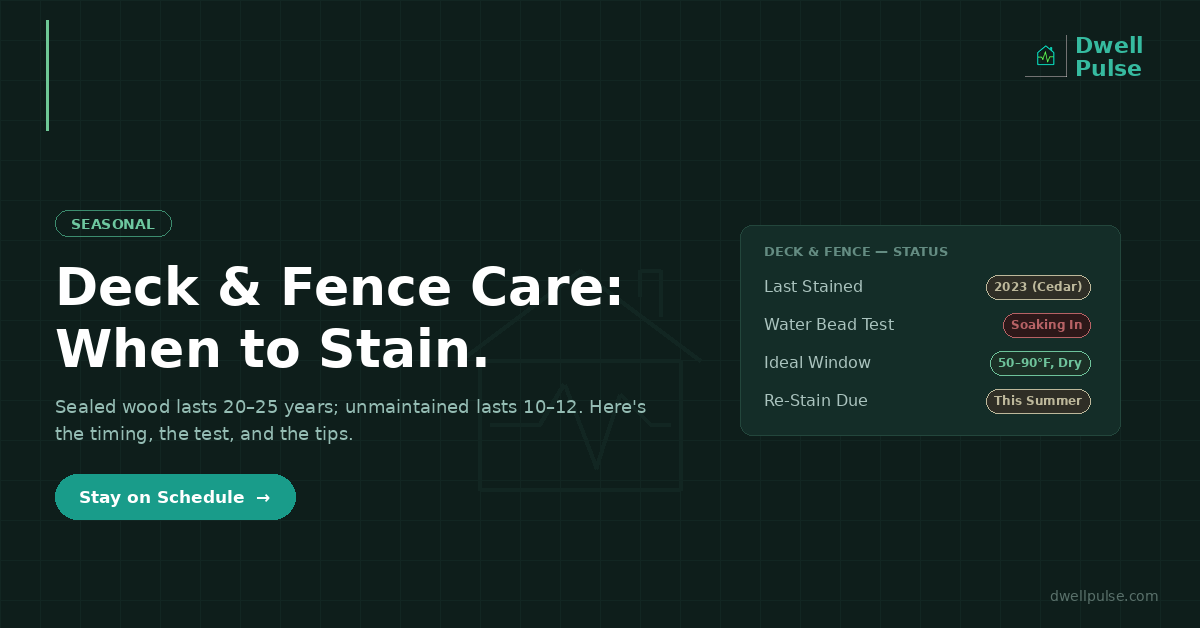
Summer is deck-and-fence season — both for enjoying them and for maintaining them. And the maintenance matters more than most homeowners realize. According to Home Innovation Research Labs, an unmaintained pine fence typically lasts just 10 to 12 years before needing full replacement, while a fence that’s cleaned and sealed every three years routinely lasts 20 to 25 years [1]. Regular staining doesn’t just keep wood looking good — it roughly doubles how long it lasts.
Here’s everything you need to know: when to do it, how often, the conditions that make or break the job, and the ten-second test that tells you whether it’s time.
How Often Should You Stain a Deck or Fence?
The general guideline is to re-stain every 2 to 3 years, though it depends heavily on the product you use and your climate [2]:
- Semi-transparent stains: every 1 to 2 years
- Solid stains: longer, often 3 to 5 years
- Clear sealers: the least UV protection, so more frequent reapplication
Several factors shorten the interval and mean you’ll need to do it more often [3]:
- Heavy sun/UV exposure — south- and west-facing surfaces weather fastest
- High foot traffic — a deck you entertain on wears faster than a fence
- Harsh climates — intense sun, heavy rain, or freeze-thaw cycles all accelerate wear
- Horizontal surfaces — deck boards take far more abuse than vertical fence boards, so decks generally need re-staining more often than fences
In very sunny regions, you may need to reseal a deck as often as once a year to keep up with UV damage [4].
The Water Test: How to Know It’s Actually Time
Don’t guess — test. The simplest, most reliable way to know whether your deck or fence needs re-sealing is the water bead test [4]:
Sprinkle a few drops of water on the wood surface.
- If the water beads up into droplets, your sealant is still working. You’re good.
- If the water soaks into the wood within a few minutes, the protective barrier has worn down and it’s time to reapply.
Combine that with a visual check. Other signs it’s time: faded or graying wood, water no longer beading, visible cracks or splintering, and any green or black spots that signal mold or mildew [4]. Catching wear early matters — a deck that’s just starting to show wear is far easier and cheaper to clean and reseal than one neglected for several seasons.
When Is the Best Time to Stain?
Timing is genuinely make-or-break for a staining job. Get the conditions wrong and the stain won’t cure properly, leaving you with a sticky, blotchy, peeling mess. The ideal conditions [5]:
- Temperature between 50°F and 90°F (many pros prefer a tighter 50–80°F window), holding steady for about 48 hours [1][6].
- Low humidity — high humidity prevents proper curing.
- No rain in the forecast for at least 24 hours — ideally longer, so the finish can fully cure.
- Out of direct, scorching sun. This is the mistake that surprises people: applying stain in hot direct sunlight causes it to dry on the surface before it can penetrate the wood, leaving a film that peels rather than a stain that protects [7]. Work in the shade, or follow the shade around the deck as the day moves.
Best seasons: late spring/early summer and early fall offer the most consistently stain-friendly conditions — moderate temperatures and lower humidity [2]. Summer works well as long as you avoid staining in the midday heat and pick a dry stretch. Staining before fall means your wood heads into winter fully protected.
Don’t Stain New or Wet Wood
Two situations where you must wait:
New pressure-treated lumber needs to dry out before it will accept stain — typically 4 to 12 weeks after installation, sometimes up to 60 days, depending on how wet it was when treated and your local weather [8]. Stain it too soon and it won’t absorb, leading to peeling. Use the same water test: when the wood readily absorbs water rather than beading it, it’s dry enough to stain.
After cleaning or rain, wait 24 to 48 hours for the wood to dry completely before applying any finish [9]. Trapped moisture under a fresh coat is the number-one cause of peeling, blistering, and accelerated rot.
A Few Application Tips That Matter
- Clean first, but skip the chlorine bleach — it damages wood fibers, strips natural color, and kills nearby plants. Use a dedicated deck/wood cleaner.
- Go easy with the pressure washer. A high-pressure nozzle held too close cuts into the wood, raising the grain and causing splinters. Use a wide-angle tip and keep the wand at least 12 inches from the surface [1].
- Coat the end grain twice. The tops and bottoms of fence boards and the cut ends of deck boards absorb water fastest, so two coats on exposed end grain dramatically extends board life [9].
- Thin, even coats beat heavy ones. One coat back-brushed into the grain protects better than two heavy coats that puddle and peel [9].
- Stain, don’t paint. Paint creates a film that eventually traps moisture and leads to rot; stain penetrates and lets the wood breathe [1].
Why Tracking This Pays Off
The whole reason a fence lasts 25 years instead of 12 is consistency — sealing it every few years, on schedule, before the wood is damaged. But a 2-to-3-year interval is exactly the kind of thing that’s impossible to remember. Was it two summers ago you stained the deck, or three? Which fence sections got done last time? What brand and color did you use, so the next coat matches?
Miss the window by a couple of years and the wood grays, cracks, and starts to rot — and now you’re looking at board replacement or a full rebuild instead of a weekend re-coat. The maintenance is cheap; the neglect is expensive. The only hard part is remembering to do it on time.
How DwellPulse Helps
DwellPulse keeps your deck and fence maintenance on schedule so the wood actually gets its full 20-plus years. Set a recurring reminder for the 2-to-3-year re-stain interval, and log each time you do it — the date, the product brand and color, and the finish — so you know exactly what you used and when, and the next coat matches perfectly. Store photos and the stain product details so a future touch-up or a new homeowner isn’t guessing. Track your deck and fence as outdoor projects with their materials and costs, and because DwellPulse can factor in the weather, you’ll know when a dry, mild window is coming to actually get the job done. Consistent care is what separates a deck that lasts decades from one you’re rebuilding in ten years — and DwellPulse is how you stay consistent.
Keep your deck and fence on schedule →
Sources: [1] Justice Fence, “Easy Wood Fence Staining and Sealing Guide 2026,” May 2026, citing Home Innovation Research Labs on unmaintained pine fences lasting 10–12 years vs. 20–25 years with sealing every three years, the 50–80°F/48-hour application window, pressure-washer technique, and stain-vs-paint. [2] Madison Stain & Seal, “How Often Should You Stain Your Deck or Fence?” March 2026, and JW Lumber, “How Often Should You Re-Stain?” September 2025, on the 2–3 year interval and finish-type differences. [3] JW Lumber, on sun exposure, foot traffic, and wear accelerating restaining frequency. [4] AllBright Painting, “Deck Sealing & Staining Guide,” October 2025, on the water-bead test, once-a-year sealing in high-UV regions, and visual wear signs. [5] AllBright Painting and DJ Fence, “When to Stain a Deck,” July 2025, on ideal conditions (mild temps, low humidity, 24+ hours no rain, avoiding direct sun). [6] Mr. Handyman, “Best Temperature to Stain a Deck,” on the 50–90°F range and every-3-4-year maintenance for wood preservation. [7] Fence Advisors, “Fence Staining 101,” March 2026, on staining in direct sun causing surface films that peel and end-grain coating. [8] DJ Fence and Treated Wood, “Staining Decks and Fences,” on pressure-treated lumber needing 4–12 weeks (up to 60 days) to dry before staining. [9] Fence Advisors, on waiting 24–48 hours after cleaning, double-coating end grain, and thin even coats; and on chlorine bleach damaging wood.
* This article was written with the assistance of AI tools. All content is reviewed and edited by Josh Standeven.
Ready to take control of your home?
DwellPulse is free to start — track maintenance, projects, appliances, and your garden all in one place.
Start Free Today →