Every Receipt Is a Tax Deduction You'll Forget: How to Track Home Improvements for Resale
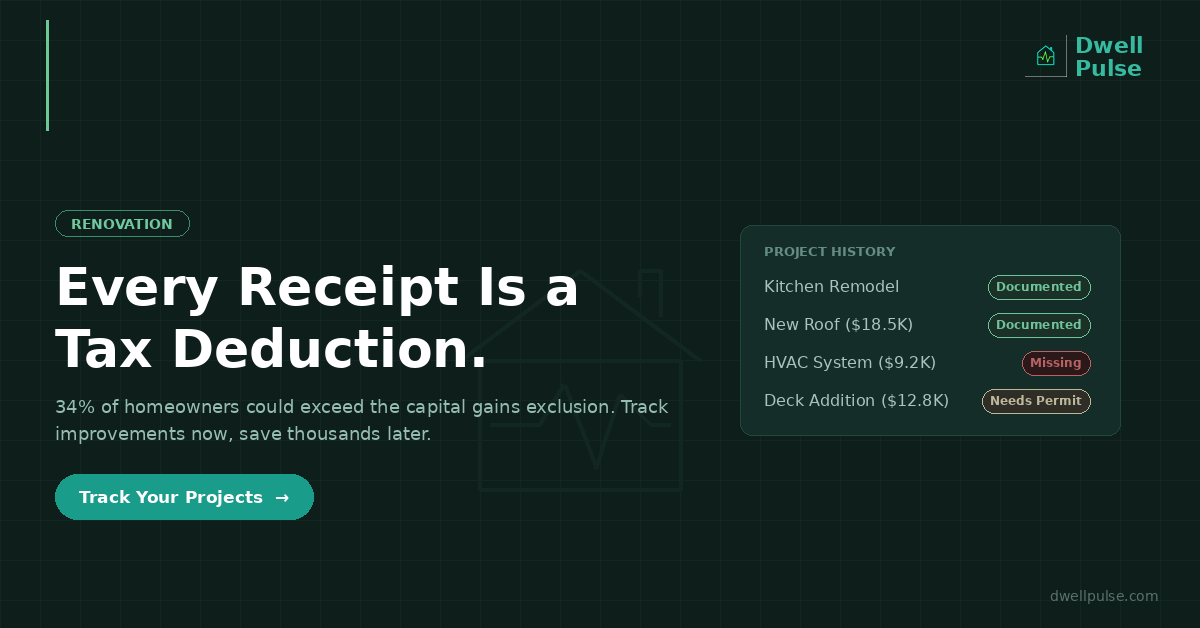
You replaced the roof in 2019. You remodeled the kitchen in 2021. You added a deck, upgraded the HVAC system, and replaced every window in the house over the next three years. You spent a combined $95,000 on capital improvements. Now you’re selling.
If you can prove that $95,000 in improvements, it gets added to your cost basis — meaning your taxable gain drops by $95,000. At a 15% capital gains tax rate, that’s $14,250 you don’t owe the IRS. At the 20% rate plus the 3.8% net investment income tax, it’s over $22,000.
If you can’t prove it — if the receipts are lost, the contractors are gone, and you can’t document what you spent — that $95,000 might as well not exist. You pay full tax on gains you already spent to create. This is not a theoretical risk. It is one of the most common and most expensive documentation failures in residential real estate.
The Exclusion That Isn’t Enough Anymore
When Congress set the capital gains exclusion limits in 1997, $250,000 for single filers and $500,000 for married couples covered virtually every home sale in America. That was nearly three decades ago. Home prices have risen 147% in the last 15 years alone. The median existing home price reached $415,200 in late 2025 [1]. In markets like California, Colorado, and Florida, homes regularly appreciate $500,000 or more over a 20-year ownership period. According to the National Association of Realtors, an estimated 29 million homeowners — 34% — could now exceed the $250,000 single-filer exclusion, and roughly 8 million (10%) could exceed the $500,000 married-couple limit [2].
The exclusion limits haven’t been adjusted for inflation since 1997. A Congressional Research Service report noted that if the original limits had been indexed to average home prices, they’d be approximately $720,000 and $1,440,000 today [3]. They weren’t indexed. They haven’t moved.
This means a growing share of homeowners will owe capital gains tax when they sell — and every dollar of documented improvement that raises the cost basis directly reduces the taxable gain.
What Counts as a Capital Improvement
Not every dollar you spend on your home qualifies. The IRS draws a clear line between capital improvements and repairs [4].
A capital improvement adds value to the home, prolongs its useful life, or adapts it to new uses. It must be permanent and still exist when you sell the home. Examples include a new roof, a kitchen remodel, a bathroom addition, new windows, an HVAC system replacement, a deck or patio addition, a finished basement, new flooring, landscaping (permanent, not seasonal), insulation, and solar panel installation.
A repair returns something to its original condition without adding value. Fixing a leaky faucet, patching drywall, replacing a broken window pane, repainting a room (unless it’s part of a larger renovation), and cleaning gutters are all repairs. Repairs do not increase your cost basis.
The distinction matters because the IRS requires documentation that each project meets the definition of an improvement. “I replaced the roof” is a claim. A dated invoice from the roofing contractor, showing the scope of work and total cost, is proof.
What the IRS Actually Wants to See
The IRS doesn’t audit every home sale. But when it does — or when you’re claiming capital improvements to reduce a gain above the exclusion — it expects specific documentation [5]:
- Dated receipts and invoices showing the contractor or supplier, the scope of work, and the total cost. These are the foundation.
- Canceled checks or credit card statements proving the amounts were actually paid. An invoice alone isn’t enough if the IRS questions whether you actually paid it.
- Building permits for any work that required one. Permitted work is stronger documentation than unpermitted work, and some improvements done without permits may not be recognized at all.
- Before-and-after photographs showing the condition of the home prior to the improvement and the completed result. These are not required by the IRS, but they are powerful supporting evidence and extremely useful if an improvement is ever questioned.
- Contracts or written agreements with contractors, especially for large projects.
The IRS generally expects you to retain these records for at least three years after filing the tax return for the year you sell — but since the improvements may span decades of ownership, the practical advice is to keep them for as long as you own the home, plus seven years after you sell [6].
Why Most Homeowners Lose This Money
The documentation requirements are straightforward. The reason most homeowners fail to benefit from them is simpler: life happens over decades, and paperwork doesn’t survive the way houses do.
A roof replacement in 2019 generated a receipt that went into a kitchen drawer. A kitchen remodel in 2021 produced invoices from three contractors, a permit, and a stack of material receipts from two different home improvement stores. A window replacement in 2023 came with a single invoice from the installer. The deck was built by a friend-of-a-friend who gave a handwritten estimate and was paid in three Venmo installments.
Seven years later, you’re preparing to sell. The kitchen drawer has been cleaned out twice. The email with the roofing invoice is buried under 40,000 other emails. The permit is at city hall but you’d need to request a copy. The handwritten deck estimate is gone entirely.
Every lost receipt is money you effectively give to the IRS.
Building a System That Survives 20 Years
The homeowners who benefit from cost basis documentation aren’t more organized by nature. They simply have a system that doesn’t depend on a single drawer, a single email account, or their own memory.
Capture at the point of payment. The moment you pay a contractor or buy materials, the receipt goes into the system — photographed, categorized, and linked to the specific project. Not “sometime this weekend.” Not “when I get around to it.” The moment the transaction happens.
Link documents to projects, not folders. A folder labeled “Home Improvements” with 47 loose PDFs is nearly as bad as the kitchen drawer. Each improvement project should be a distinct record with its own receipts, invoices, permits, photos, and total cost — because that’s how you’ll need to present it on a tax return.
Track the running total. Your adjusted cost basis is your original purchase price plus the sum of all capital improvements minus any depreciation (for rental use). Knowing this number at any point during ownership lets you make informed decisions about whether to sell, how much to invest in the next project, and whether you’re approaching the exclusion threshold.
Include before-and-after photos. A ten-second photo of the old kitchen before demolition day, and another of the finished result, is the cheapest and most powerful documentation you can create. Do this for every project.
How DwellPulse Helps
DwellPulse’s Projects feature is built for exactly this problem. Each home improvement project gets its own record — with a description, start and end dates, contractor information, total cost, and a document vault for receipts, invoices, permits, and before-and-after photos. Every project is linked to the property, so when it’s time to sell, your complete improvement history is in one place, organized by project, with running cost totals.
Track expenses at the project level with individual line items so you can see what you spent on materials versus labor. Upload contractor invoices the day they arrive. Attach permits and inspection reports. Add photos from your phone while you’re still standing in the finished room. The Expense Forecast feature shows you where your home investment stands at any point — not just the purchase price, but the adjusted cost basis with every improvement factored in.
When you sell, export or share your property’s complete project history with your accountant or tax advisor. Every improvement, every receipt, every dollar — documented and provable.
Start tracking your home improvements →
Sources: [1] National Association of Realtors, median existing home price $415,200 as of October 2025, via Cotality and AmerSave. [2] National Association of Realtors 2025 report via CNBC, “Some Lawmakers Want to Cut Capital Gains Taxes on Home Sales,” March 2026, estimating 29 million homeowners (34%) could exceed the $250K exclusion. [3] Congressional Research Service, “The Exclusion of Capital Gains for Owner-Occupied Housing,” noting inflation-adjusted limits would be approximately $720,000 and $1,440,000. [4] IRS Publication 523, “Selling Your Home,” and IRS Publication 551, “Basis of Assets,” via ConsumerAffairs, July 2025. [5] SmartAsset, “Capital Improvements: Real Estate Guide,” November 2025. [6] Jackson Hewitt, “Home Improvement Tax Deductions 2025,” March 2026.
*Writing assisted by AI
Ready to take control of your home?
DwellPulse is free to start — track maintenance, projects, appliances, and your garden all in one place.
Start Free Today →