Guild Gardening for Beginners: How Companion Plant Groups Outperform Solo Planting
Most backyard gardeners plant in rows. Tomatoes in one row, peppers in another, basil somewhere off to the side. It works — but it leaves a lot on the table. Nature doesn’t grow in rows. It grows in communities.
A plant guild is a group of companion plants deliberately placed together because they protect, feed, and support each other. The concept comes from permaculture design, but you don’t need a permaculture certification or a five-acre homestead to use it. Guilds work in raised beds, container gardens, and backyard plots of any size — and the research backing them has only gotten stronger.
What Is a Plant Guild?
A guild is a group of plants assembled around a central crop, where every member serves at least one function that benefits the group. Functions might include fixing nitrogen in the soil, repelling pests, attracting pollinators, shading the ground to suppress weeds, or providing a physical structure for other plants to climb.
The term comes from permaculture, where a guild is formally defined as a harmonious assembly of species clustered around a central element that supports that element’s health, reduces management effort, or buffers adverse conditions [1]. But the practice is far older than the terminology. Indigenous peoples across North America, including the Haudenosaunee (Iroquois), cultivated guilds for thousands of years — the most famous being the Three Sisters.
The key distinction between a guild and simple companion planting is intentionality. Companion planting pairs two plants that don’t harm each other. A guild designs a system where every plant has a role and the group performs better together than any member would alone.
The Three Sisters: A Guild That’s Worked for Thousands of Years
The most iconic plant guild is the Three Sisters — corn, beans, and squash — grown together on mounded soil. This combination has been cultivated by Indigenous peoples of North America for roughly five millennia, and modern research continues to confirm what traditional knowledge has long held [2].
Here’s how the roles break down:
- Corn grows tall and straight, providing a living trellis for the beans to climb. It needs heavy nitrogen to fuel that growth.
- Beans (pole varieties) climb the corn stalks, eliminating the need for artificial supports. More importantly, beans are nitrogen fixers — their root nodules host bacteria that convert atmospheric nitrogen into a form plants can absorb, feeding the corn and squash growing beside them.
- Squash sprawls across the ground at the base of the corn and beans, creating a living mulch. Its broad leaves shade the soil, suppressing weeds and retaining moisture. The prickly stems and leaves of many squash varieties also deter animal pests from reaching the corn and beans [3].
The result is a self-supporting system that produces carbohydrates, protein, and vitamins from a single mound of soil — with no synthetic fertilizer, no trellising hardware, and dramatically less weeding.
Beyond the Three Sisters: Guilds for Raised Beds
The Three Sisters is a large-scale guild — it needs a 4-foot mound and plenty of room for the squash to sprawl. Most backyard gardeners work in raised beds of 4×4 or 4×8 feet, where space is tighter. Fortunately, the guild principle adapts easily.
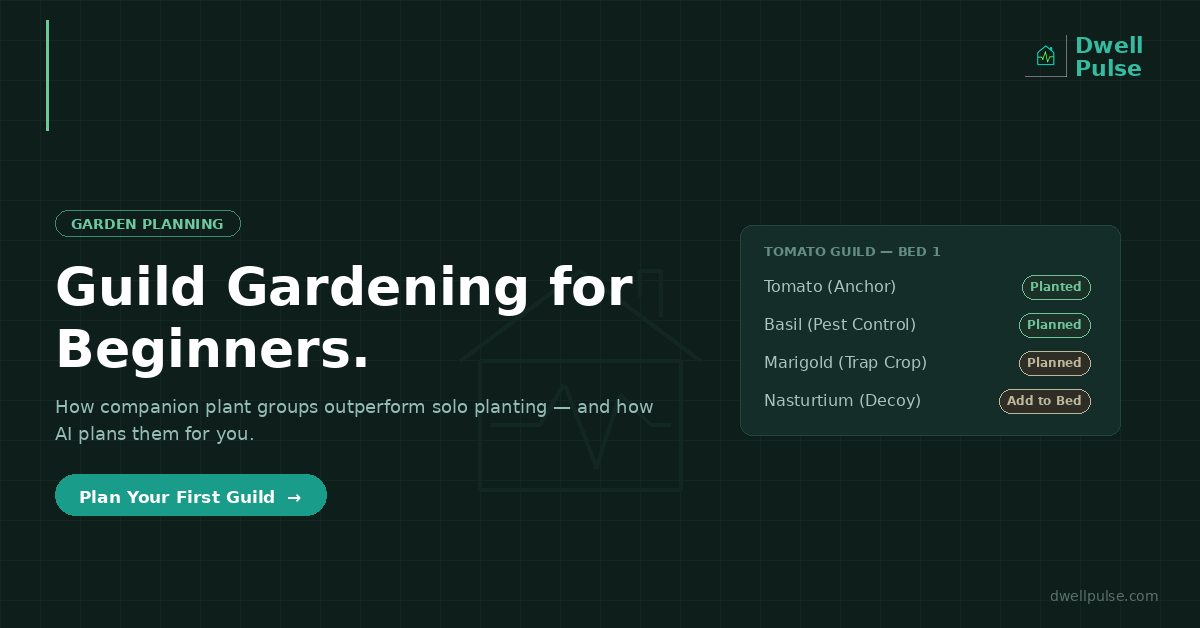
The tomato guild. Tomatoes as the anchor, underplanted with basil (repels aphids and may improve tomato flavor), surrounded by marigolds (repel nematodes and whiteflies), with nasturtiums at the edges as a trap crop that draws aphids away from the tomatoes. Parsley or carrots can fill gaps — their deep taproots break up compacted soil and their flowers attract beneficial predatory insects like hoverflies and parasitic wasps [4].
The brassica guild. Kale or broccoli as the center crop, with dill and chamomile nearby to attract beneficial wasps that prey on cabbage worms. Onions or garlic at the perimeter deter aphids and flea beetles. Low-growing clover between plants fixes nitrogen and acts as a living mulch. Avoid planting strawberries or pole beans near brassicas — they compete poorly together.
The herb spiral guild. Rosemary, thyme, sage, oregano, and lavender planted in a spiral or clustered arrangement. Mediterranean herbs share similar sun, water, and drainage needs, and the aromatic oils they release suppress many common pests. Tuck chives at the base for their allium pest-repelling properties, and let a few herbs flower to attract pollinators.
The pepper guild. Peppers as the anchor, with basil and oregano interplanted (both improve pest resistance), carrots filling the understory (their deep roots don’t compete with pepper’s shallow ones), and a ring of marigolds at the border. Spinach or lettuce planted in the pepper’s shadow acts as a cool-season ground cover early in the season.
Why Guilds Outperform Monoculture Rows
Research increasingly supports what traditional growers have observed for centuries. Diverse plantings can lower pest populations, improve soil health, and boost yields compared to monoculture rows [1]. The mechanisms are well understood:
- Pest confusion. Many insect pests locate host plants by scent. When strong-smelling companions like basil, marigolds, or alliums are interplanted, the chemical signals get scrambled. Pests land on the wrong plant, spend energy searching, and lay fewer eggs on the target crop.
- Beneficial insect habitat. Flowering herbs and companion plants attract predatory insects — ladybugs, lacewings, parasitic wasps, hoverflies — that eat the pests you don’t want. A monoculture row of tomatoes offers nothing for these allies. A tomato guild with flowering basil, dill, and marigolds is a buffet.
- Soil biology. Nitrogen-fixing plants like beans, clover, and peas genuinely enrich the soil for their neighbors. Their root nodules host Rhizobium bacteria that convert atmospheric N₂ into ammonium that surrounding plants can access. This is not folklore — it’s one of the best-studied processes in soil science.
- Microclimate management. Tall plants shade shorter, cool-season crops that would otherwise bolt in midsummer heat. Ground-cover plants reduce soil temperature and evaporation. The guild creates layers of microclimates within a single bed, extending the productive season for multiple crops simultaneously.
The Hard Part: Planning Guilds Correctly
The concept is elegant. The execution is where most gardeners stall out. A good guild requires matching plants that share compatible light, water, and spacing requirements while also fulfilling complementary roles — and doing all of this within the specific square footage and sun exposure of your actual bed.
Most companion planting charts tell you which pairs work and which don’t. They don’t tell you how to assemble a complete, balanced guild for a 4×8 raised bed with partial afternoon shade in Zone 7a. That requires cross-referencing spacing requirements, days to maturity, sun needs, watering needs, planting dates, and companion compatibility across five or six species simultaneously. It’s the kind of problem that’s easy to describe and genuinely tedious to solve by hand.
How DwellPulse Helps
This is exactly the problem DwellPulse’s AI Guild Builder was designed to solve. At the individual garden bed level, you’ll find an “Add Guild” button that opens the guild planner. Tell it what you want to anchor the bed with — tomatoes, peppers, brassicas, herbs — and the AI assembles a complete companion guild tailored to your bed’s specific dimensions, sun exposure, soil depth, and USDA growing zone.
The guild planner doesn’t just suggest pairings. It builds a full planting plan: which plants go where in the bed, how many of each to plant given your square footage, what planting dates to target based on your local frost dates, and which companions to include for pest management, nitrogen fixing, and pollinator attraction. Each suggested plant appears as a planned crop with an “AI Builder” badge, ready for you to review, adjust, and approve before anything gets added to your planting calendar.
Because the guild is planned at the bed level — not the garden level — you can run different guilds in different beds. A tomato guild in Bed 1, a Three Sisters adaptation in Bed 2, an herb spiral in Bed 3. The companion planting panel on each bed view shows you which plants are helping each other and flags any conflicts, so you can see the relationships working in real time.
Plan your first guild →
Sources: [1] Milkwood Permaculture, “Companion Planting with Permaculture,” citing Mollison and Jacke on guild definitions and research on diverse plantings, February 2025. [2] The Mountain Buzz, “The Three Sisters: The Timeless Benefits of Planting Corn, Green Beans, and Squash Together,” May 2026, citing research on enhanced chemical defenses in maize. [3] Resilience.org, “Vanishing Crop Varieties, Permaculture and Food Forestry Benefits, and Three Sisters Gardening,” citing FAO research, February 2022. [4] The Old Farmer’s Almanac, “Companion Planting Chart,” updated March 2026.
*Writing assisted by AI
Ready to take control of your home?
DwellPulse is free to start — track maintenance, projects, appliances, and your garden all in one place.
Start Free Today →