How Often Should You Do Every Home Maintenance Task? The Complete Frequency Guide
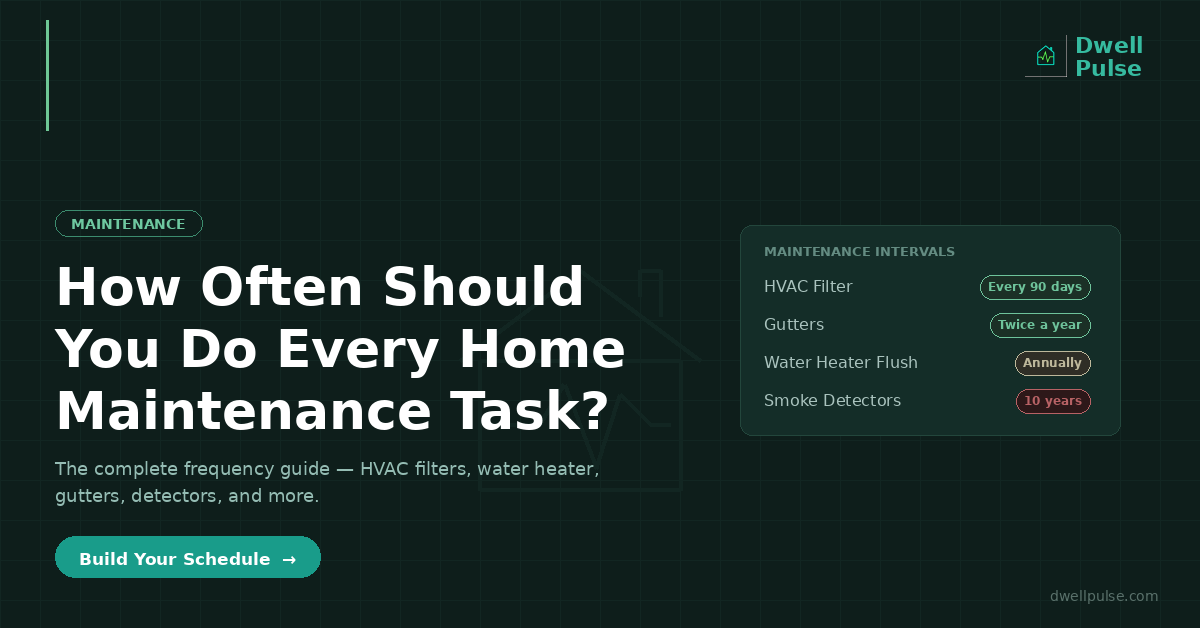
Most home maintenance advice tells you what to do but not how often — which is the part that actually determines whether your home stays in good shape. Do a task too rarely and small problems compound into expensive failures; there’s rarely harm in doing it more often, but knowing the right baseline is what keeps a home running without becoming a second job.
This is a complete frequency reference for the maintenance tasks that matter, organized from most to least frequent. Bookmark it, and use it to build a schedule you’ll actually follow.
Quick Reference: Home Maintenance Frequency
Monthly
- Check (and change if dirty) HVAC filters
- Clean the garbage disposal
- Clean range hood filter (varies with cooking)
- Test the generator, if you have one (during storm season)
- Clean the dryer lint trap — actually every load
Every 3 Months (Quarterly)
- Replace HVAC filters (standard 1-inch disposable)
- Test smoke and carbon monoxide detectors
- Test the garage door auto-reverse safety feature
- Run water in unused sinks and flush unused toilets
- Check water softener salt
Twice a Year (Biannually)
- Clean gutters and downspouts (spring and fall)
- Test the water heater’s pressure-relief valve
- Deep-clean the dryer vent duct
- Inspect and replace weatherstripping/caulking
- Reverse ceiling fan direction (seasonal)
Annually
- Professional HVAC service (tune-up before heating and cooling seasons)
- Flush the water heater (tank models)
- Inspect the roof (and after major storms)
- Inspect the home’s exterior, siding, and foundation
- Chimney inspection/cleaning (if used)
- Check for pests and termites
Every Several Years or by Lifespan
- Replace smoke/CO detectors — every 10 years
- Re-stain deck/fence — every 2–3 years
- Repaint exterior — every 5–10 years
- Replace water heater — 8–12 years
- Replace HVAC system — 15–20 years
- Replace roof — 20–30 years (asphalt shingle)
Monthly Tasks, Explained
HVAC filters — check monthly. This is the most important recurring task in the house. Check your filter every 30 days and hold it up to a light — if you can’t see light through it, replace it [1]. Homes with pets, allergies, or heavy use often need monthly replacement; others can stretch to every 90 days. A clogged filter chokes airflow, spikes energy use, and shortens the life of the whole system [2].
Dryer lint trap — every load. Clean it after every single use. Lint buildup is a leading cause of house fires and it cuts your dryer’s efficiency [3].
Garbage disposal and range hood — monthly. A quick disposal cleaning prevents odors and clogs; the range hood filter needs attention based on how much you cook.
Quarterly Tasks, Explained
HVAC filters (standard) — every 90 days. If you’re not checking monthly, the firm rule for standard 1-inch disposable filters is every three months. Consumer Reports notes disposable filters generally last 3 to 12 months depending on the system and your environment — but 90 days is the safe default [4].
Smoke and CO detectors — test quarterly, batteries twice a year. Press the test button on every unit. The NAHB recommends checking batteries at least twice per year — the classic reminder is when the clocks change [1].
Garage door auto-reverse — test quarterly. Federal law requires garage doors to auto-reverse when something’s in their path. Place a 2×4 flat on the floor in the door’s path; if the door doesn’t reverse on contact, the opener needs service [5].
Twice-a-Year Tasks, Explained
Gutters — clean spring and fall. Clogged gutters cause water damage to the roof, foundation, and walls, and in winter they form ice dams. Clean them at least twice a year — more if you have overhanging trees [2].
Dryer vent duct — deep clean every 6 months. Separate from the lint trap, the full vent duct needs periodic deep cleaning to prevent fire hazards and keep the dryer efficient [2].
Water heater pressure-relief valve — test twice a year. Lift the lever briefly; water should flow and stop cleanly. A valve that drips or won’t flow needs replacement.
Annual Tasks, Explained
HVAC professional service — once a year. A yearly tune-up (ideally before your heaviest-use season) catches problems early and is often required to keep the manufacturer’s warranty valid.
Water heater flush — once a year. Flushing a tank water heater removes the sediment that reduces efficiency and shortens its life. As one homeowner put it, a $40 flush kept postponed became a $1,200 emergency replacement [3]. This is one of the highest-return annual tasks.
Roof inspection — once a year, plus after storms. Look for missing, curling, or damaged shingles and damaged flashing. Catching a small issue early prevents interior water damage [2].
How Often Should You Replace Major Systems?
For the big-ticket items, “frequency” becomes “lifespan.” These are the widely accepted replacement ranges [6]:
- Smoke/CO detectors: every 10 years (per the U.S. Fire Administration), regardless of whether they still test okay
- Water heater (tank): 8–12 years
- HVAC system: 15–20 years
- Roof (asphalt shingle): 20–30 years
- Exterior paint: every 5–10 years
- Deck/fence re-stain: every 2–3 years
Knowing these lifespans lets you budget for replacements before they happen instead of scrambling when something fails.
Frequently Asked Questions
How often should you change your HVAC air filter? Check it every 30 days and replace at least every 90 days. Homes with pets, allergies, or heavy use may need monthly replacement [1][4].
How often should you flush your water heater? Once a year for tank models, to remove sediment that reduces efficiency and shortens the unit’s life [3].
How often should you clean your gutters? At least twice a year — typically spring and fall — and more often if you have overhanging trees [2].
How often should you test smoke and carbon monoxide detectors? Test every unit quarterly, replace the batteries at least twice a year, and replace the detectors themselves every 10 years [1][6].
How often should you have your HVAC serviced professionally? Once a year, ideally before your heaviest-use season, which also helps keep the manufacturer warranty valid.
How often should you clean your dryer vent? Clean the lint trap after every load, and deep-clean the full vent duct about every six months to prevent fire hazards [2][3].
How often should you inspect your roof? At least once a year, plus after any major storm, hail, or high wind event [2].
Why a Frequency Guide Only Works If You Track It
Here’s the honest problem with every reference like this one: knowing that gutters need cleaning twice a year and the water heater needs flushing annually does nothing if you can’t remember when you last did either. Monthly, quarterly, biannual, and annual tasks on different clocks are genuinely impossible to keep straight in your head — which is why most homeowners default to doing nothing until something breaks.
The tasks that prevent expensive failures are the recurring ones, and their entire value comes from consistency. A list gives you the schedule. It can’t run it for you.
How DwellPulse Helps
DwellPulse turns this frequency guide into a system that runs itself. Set each task on its correct interval — monthly filter checks, quarterly detector tests, biannual gutter cleanings, annual water heater flushes — tied to the specific system it belongs to, and get reminded when each is due. Log tasks as you complete them to build a maintenance record that proves the work was done. Track your major systems with their ages and lifespans, so replacement timing for the water heater, HVAC, and roof is planned rather than sudden. Build the schedule once, and every task shows up when it should — so you stop relying on memory and start actually staying ahead of your home.
Turn this guide into your maintenance schedule →
Sources: [1] Opendoor, “Home Maintenance Checklist: Monthly, Quarterly, and Seasonally,” March 2026, citing NAHB battery-check guidance and 30-day HVAC filter checks. [2] DSLD Homes, “How Often Should You Do These Home Tasks,” April 2025, on 90-day filters, twice-yearly gutter cleaning, annual water heater flush and roof inspection, and six-month dryer vent cleaning. [3] MK Library, “The Comprehensive Home Maintenance Checklist,” May 2026, on cleaning the dryer lint trap every load and the $40-flush-vs-$1,200-replacement example. [4] Consumer Reports via AOL, “6 Vital Home Units,” and AAA, “Home Maintenance Checklist,” on disposable filters lasting 3–12 months and the 90-day quarterly default. [5] AAA, “Home Maintenance Checklist,” on the federally required garage door auto-reverse test. [6] U.S. Fire Administration via HGTV/AAA on the 10-year smoke detector replacement rule; lifespan ranges for water heaters, HVAC, and roofing per industry consensus (see our dedicated guides on each).
* This article was written with the assistance of AI tools. All content is reviewed and edited by Josh Standeven.
Ready to take control of your home?
DwellPulse is free to start — track maintenance, projects, appliances, and your garden all in one place.
Start Free Today →