"How Old Is the Roof?" — The Question Every Listing Agent Dreads, and a Better Way to Answer It
You’ve taken the listing. The photographer is booked, the comps are pulled, and the MLS entry is half-filled. Then you hit the section every listing agent knows by heart: how old is the roof? When was the HVAC installed? What year are the appliances? Is the water heater original to the house? Have there been any major repairs?
The seller’s answers are some version of: “Uh… I think we did the roof a few years after we moved in? Maybe 2016? The furnace might be original. I’m not sure about the water heater.” You write down “approximately 2016” and a mental note to follow up, and you both move on. The listing goes live with half the systems marked “unknown” or, worse, with a guess that turns out to be wrong.
This is one of the most tedious recurring tasks in residential real estate — and one of the most quietly dangerous.
Why “Approximately 2016” Is a Liability
The casual guesswork that fills most listings creates real exposure for the agent. When a buyer discovers after closing that the “13-year-old roof” is actually 31 years old, the resulting complaint will allege misrepresentation — even if the error was an innocent transposition or a seller’s faulty memory [1]. Concealment is failing to report a defect; misrepresentation is reporting incorrect information about it. Either one is grounds for a lawsuit alleging negligence or fraud, and the listing agent is frequently named alongside the seller [1].
The scale of the problem is significant. A study cited by the National Association of REALTORS® found that 60% of sellers admit to not disclosing a known problem with their property to buyers [2]. And failure-to-disclose claims are among the most common claims filed against agents — a risk that intensified when buyers began waiving inspection contingencies in competitive markets [2].
The standard guidance from NAR counsel is clear: agents should never complete a disclosure form on the seller’s behalf, should encourage sellers to reveal all known facts, and should review the disclosure to ensure every question is answered [2]. But all of that depends on one thing the agent rarely has — accurate source information from the seller. You can’t review a disclosure for accuracy when the underlying data is a shrug and a guess.
There’s even a measurable market cost to missing data. An academic study on MLS listings found that when a home’s age is omitted entirely, the property can appear to sell at a discount — and incomplete system information contributes to the same buyer uncertainty that drags on price and time on market [3].
The Real Problem: Sellers Don’t Have the Data Either
Here’s the part that makes this so frustrating: most of the time, the seller isn’t being evasive. They genuinely don’t know. They didn’t write down the date when the water heater was replaced in 2019. The receipt for the roof is long gone. The HVAC servicer who came every fall is a phone number in a dead phone. The information that would make your listing accurate and defensible was never recorded anywhere — it lived in the homeowner’s memory, and memory fades.
So the agent becomes a detective. You ask the seller to dig through old emails. You call the HVAC company to see if they have service records. You pull permits from the county if the jurisdiction makes that easy (many don’t). You estimate the roof age from the shingle wear in the listing photos. Every one of these is time you’re spending to reconstruct information that should have existed all along — and even after all that effort, the best you often get is “probably.”
A Better Way: Ask for the Home’s Records, Not the Homeowner’s Memory
The agents who avoid this entire scramble are the ones working with sellers who kept records — and increasingly, that means sellers who used a home management platform to track their home over the years.
When a homeowner has been maintaining their home in DwellPulse, the data you’re chasing already exists, dated and documented:
- The roof is in the system with its install date and the contractor who did it
- The HVAC system has its install date, model number, and full service history
- The water heater shows exactly when it was installed and its warranty status
- Every major appliance is logged with make, model, age, and purchase documentation
- Completed projects — the kitchen remodel, the new windows, the deck — are recorded with dates, costs, and receipts
- The maintenance history shows the home was actually cared for, not just lived in
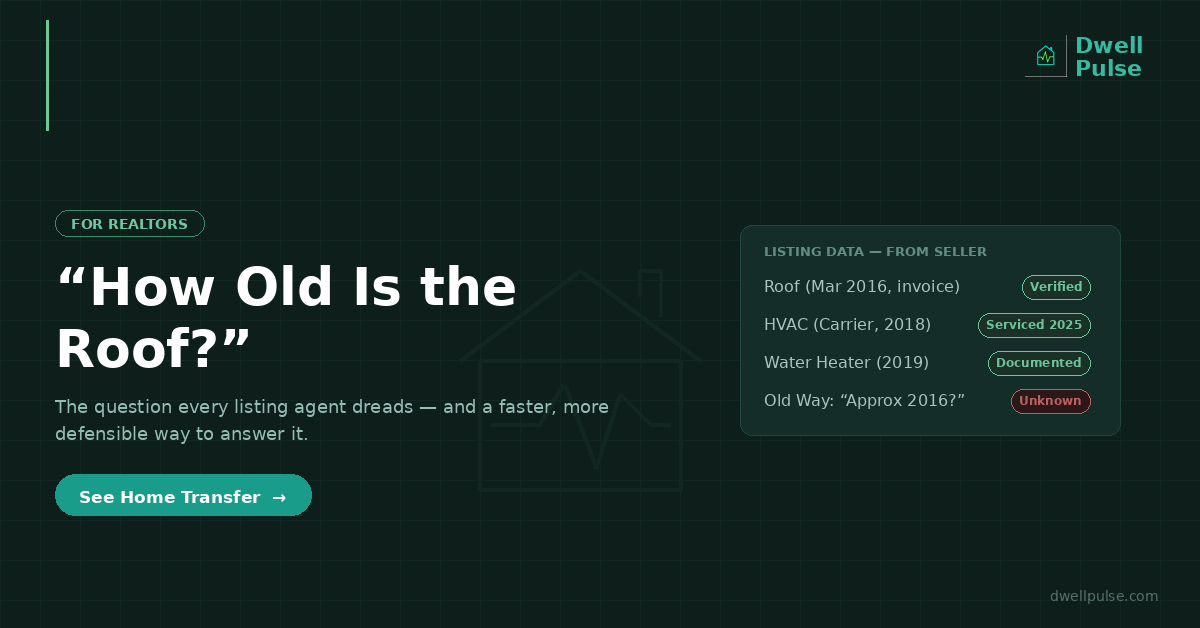
Instead of “approximately 2016,” you get “asphalt shingle roof, installed March 2016 by [contractor], with the invoice attached.” Instead of “the furnace might be original,” you get “Carrier furnace, installed 2018, serviced annually, last tune-up September 2025.” That’s not a guess you’re exposed on. That’s documented, seller-provided source data you can build an accurate listing around.
The Home Transfer Advantage
DwellPulse was built with this exact handoff in mind. Its Home Transfer feature lets a seller package their home’s complete history — systems, appliances, projects, maintenance records, and documents — into a transferable report that conveys to the buyer at closing. For the listing agent, this turns the most painful part of the intake process into a single ask: “Do you have your home’s records in DwellPulse? Great — share them with me.”
For the buyer’s side, it’s a differentiator that builds confidence. A home that comes with a documented maintenance history and verified system ages stands apart from the listing down the street where everything is “unknown.” It’s the closest thing residential real estate has to the kind of documented history buyers in other major purchases take for granted.
What This Means for Your Business
For listing agents, recommending a home management platform to clients isn’t just a value-add for the homeowner — it’s a direct investment in your own efficiency and risk management. A seller who has tracked their home for even a year or two arrives at the listing appointment with the data you need already organized. You spend less time playing detective, you list with accurate information, and you reduce the misrepresentation exposure that comes from building a disclosure on guesswork.
It also positions you as the agent who thinks ahead. Suggesting that a client start documenting their home — well before they plan to sell — is the kind of long-game advice that earns repeat business and referrals. When they’re ready to list in three years, they’ll have three years of records, and you’ll have the easiest intake of your week.
How DwellPulse Helps
DwellPulse gives homeowners a single place to document everything an agent will eventually need to list the home accurately — system install dates, appliance ages, maintenance history, project records, and supporting documents. The Home Transfer feature packages it all into a report that conveys to the buyer, turning your listing intake from a guessing game into a data handoff. For agents, it means accurate listings, lower misrepresentation risk, and a concrete reason to stay in touch with past clients between transactions. Recommend it to your sellers early, and the next listing appointment gets a lot easier.
Learn about Home Transfer for your listings →
Sources: [1] Berxi, “What Happens If a Real Estate Agent Fails to Disclose Property Defects?” February 2025, noting that even an innocent error — stating a roof is 13 years old when it is 31 — can be alleged as misrepresentation, and that misrepresentation and concealment are both grounds for negligence and fraud claims. [2] National Association of REALTORS®, “Top Claim Against Agents: Failure to Disclose,” citing a Cinch Home Services study finding 60% of sellers admit to not disclosing a known problem, and NAR counsel best practices for agents reviewing seller disclosures. [3] Bruce L. Gordon & Daniel T. Winkler, “The Omission of House Age in MLS Database Listings: The Effect on Selling Price and Time on Market,” Journal of Real Estate Research, 2020.
* This article was written with the assistance of AI tools. All content is reviewed and edited by Josh Standeven.
Ready to take control of your home?
DwellPulse is free to start — track maintenance, projects, appliances, and your garden all in one place.
Start Free Today →