How to Lower Your Cooling Bills This Summer: 8 Changes That Actually Work
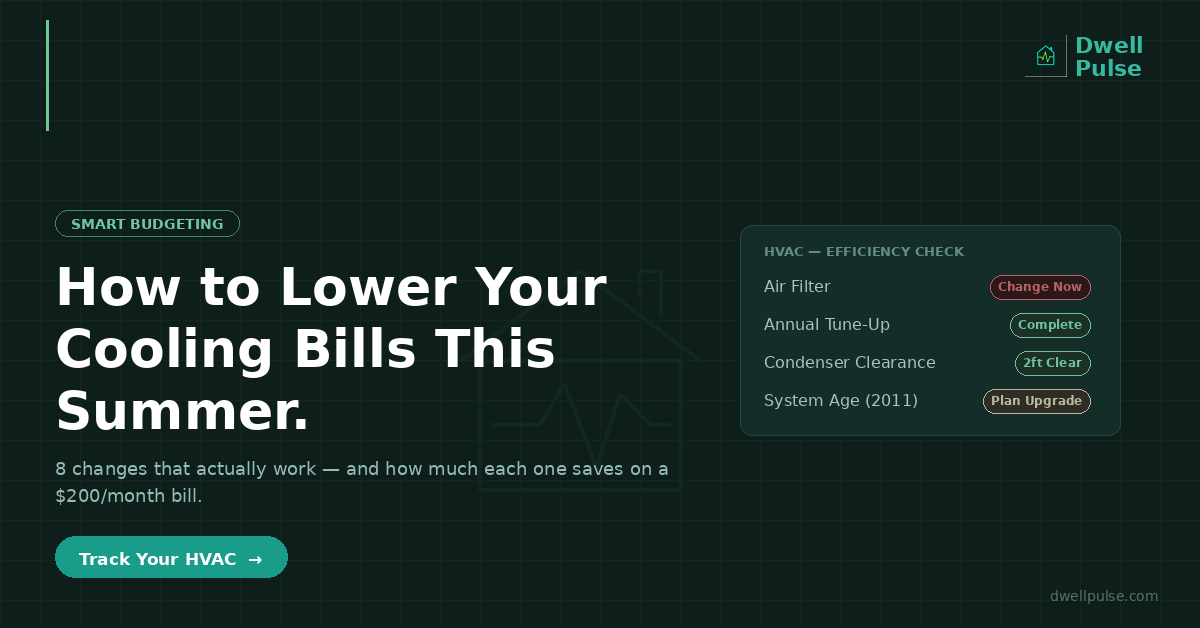
Air conditioning is the single largest driver of a summer electric bill. A central AC system draws roughly 3,000 to 5,000 watts per hour while running, which typically adds $100 to $200 per month to the average household bill during cooling season [1]. In a hot stretch, that number climbs as the system runs longer cycles just to keep up.
The good news is that cooling costs respond well to a handful of specific changes — and most of them are free or nearly free. Here’s what actually works, ranked roughly by impact, with the real numbers behind each.
1. Raise Your Thermostat (and Understand the Real Math)
The U.S. Department of Energy recommends setting your thermostat to 78°F when you’re home and awake, and raising it 7 to 10 degrees when you’re away or asleep. According to the DOE, that setback strategy alone can save up to 10% annually on heating and cooling costs [2].
The per-degree math is the part worth internalizing: each degree below 78°F adds roughly 3% to your cooling costs — utilities like Florida Power & Light put the range at 3–5% per degree [3]. FPL estimated that going from 75°F to 78°F in August saves about 42 cents a day, or roughly $12.60 for the month [3].
An honest note on 78°F: a lot of people find that genuinely uncomfortable, and there’s been real public pushback on the recommendation. You don’t have to jump straight there to benefit. Because the savings are per-degree, moving from 72°F to 74°F captures meaningful savings on its own. Some HVAC technicians suggest 72–74°F is more realistic for most households, while cautioning against going below 70°F, where energy use climbs steeply [4]. Work up gradually — the number that matters is the one you’ll actually stick with.
One caution: don’t set it above 80–85°F while away, because your system needs to cycle often enough to remove humidity and prevent mold growth [5].
2. Use Ceiling Fans to Buy Back Comfort
Ceiling fans don’t cool air — they create a wind-chill effect on your skin that makes a room feel about 4°F cooler than it is. That means you can raise your thermostat setpoint by about 4 degrees and feel the same, while the AC runs noticeably less [1].
Fans cost less than a penny an hour to run, making this one of the highest-return changes available. The critical rule: turn fans off in empty rooms. They cool people, not spaces — a fan running in an unoccupied room is pure waste.
3. Change Your Air Filter (The Most-Skipped Fix)
A dirty, clogged air filter restricts airflow and forces your system to work harder for the same result. Dirty filters can add roughly 5–15% to your cooling energy costs [1]. During heavy summer use, check the filter monthly and replace it when it looks gray and loaded.
This is also the maintenance item most directly tied to system longevity. Restricted airflow strains the blower motor and can lead to premature failure of a system that should have lasted 15–20 years.
4. Get a Programmable or Smart Thermostat
A programmable thermostat automates the setback so you’re not cooling an empty house — and it saves you from remembering. Programmable models save roughly 10% annually, and smart models (Nest, Ecobee, Honeywell) learn your patterns automatically [1].
Energy Star reports that homeowners who follow a smart thermostat schedule combined with other efficient cooling habits can save up to 23% on HVAC-related energy costs [6].
5. Manage Your Windows
Sunlight streaming through windows is a significant heat load your AC then has to remove. Close blinds, curtains, or shades on south- and west-facing windows during the hottest part of the day — west-facing windows are the biggest offender through the late afternoon, exactly when the system is already working hardest. Reopen them in the evening when the sun is off the glass.
6. Seal Leaks and Check Insulation
Conditioned air escaping through gaps around windows, doors, ductwork, and attic penetrations means you’re paying to cool the outdoors. Caulk and weatherstrip obvious gaps, and check that attic insulation is adequate for your climate zone. This is a weekend project rather than a five-minute fix, but it pays back every summer and every winter.
7. Clear the Outdoor Condenser Unit
Your outdoor unit needs to dump heat into the surrounding air, and it can’t do that efficiently if it’s crowded by shrubs, weeds, or stacked debris. Maintain at least 2 feet of clearance on all sides, and gently rinse accumulated dirt and pollen off the fins. It’s a ten-minute task that improves efficiency for the rest of the season.
8. Know When the System Itself Is the Problem
All of the above assumes your equipment is working reasonably well. If your AC is old and your bills keep climbing despite good habits and maintenance, the system may be the bottleneck.
Upgrading from an older SEER 10 system to a modern SEER 16 unit reduces cooling energy consumption by roughly 40% — for a household spending $200 a month on cooling, that’s around $80 a month [1]. Modern high-efficiency units generally use 30–50% less energy than older models, and federal tax credits and utility rebates can offset a meaningful share of the cost [7].
The practical threshold: if your system is more than 12–15 years old and bills keep rising despite maintenance, it’s time to start planning a replacement rather than absorbing another expensive summer [7].
How Much Can You Actually Save?
The biggest gains come from stacking these rather than relying on any one. A homeowner who adds a smart thermostat, seals obvious air leaks, improves attic insulation, manages window treatments, and stays current on HVAC maintenance can realistically cut summer cooling costs by 25% to 40% — often without a noticeable drop in comfort [7].
How DwellPulse Helps
Most of what lowers a cooling bill is maintenance you have to actually remember to do. DwellPulse keeps it on track: set recurring reminders for monthly filter changes during heavy-use months and annual pre-season HVAC tune-ups, tied to your actual system with its model, install date, and service history. Log each tune-up and filter change so you build a documented maintenance record — the kind manufacturers often require to honor a warranty claim. Because DwellPulse tracks your HVAC system’s age against its expected lifespan, you’ll see the replacement coming years ahead and can plan for a high-efficiency upgrade on your schedule instead of during an August failure. And with National Weather Service integration, DwellPulse surfaces heat advisories for your property, so you can prepare before the worst stretch hits.
Track your HVAC and stay ahead of it →
Sources: [1] ElectricRates.org, “Summer Electricity Costs: AC Efficiency & Savings Guide 2026,” on central AC wattage and monthly cost impact, the ~3–4% per degree figure, ceiling fans allowing a 4°F setpoint increase, dirty filters adding 5–15%, programmable thermostats saving ~10%, and SEER 10→16 reducing consumption ~40%. [2] U.S. Department of Energy, thermostat guidance recommending 78°F when home and awake and a 7–10°F setback for 8 hours a day saving up to 10% annually, via Trane, “Should You Really Set Your Thermostat to 78 in the Summer?” April 2026. [3] Florida Power & Light via Yahoo/USA TODAY Network, “Save money setting your summer thermostat to 78 degrees, utilities say,” citing 3–5% added cost per degree below 78°F and the 75°F→78°F August savings estimate. [4] Logan Services technician Damon Cantrell via WCPO, “The best AC temperature setting for electric bill savings,” June 2026, on 72–74°F being realistic for most households and avoiding settings below 70°F. [5] Trane, on not exceeding 80–85°F while away to maintain humidity control. [6] Energy Star via Reader’s Digest, “Best Time of Day to Adjust Your Thermostat,” June 2026, on up to 23% HVAC energy savings. [7] GreenLife, “5 Ways to Save Money on Your AC and Summer Energy Bill,” May 2026, on SEER 16+ using 30–50% less energy, the 12–15 year replacement threshold, and 25–40% total savings from combined strategies.
* This article was written with the assistance of AI tools. All content is reviewed and edited by Josh Standeven.
Ready to take control of your home?
DwellPulse is free to start — track maintenance, projects, appliances, and your garden all in one place.
Start Free Today →