Pool Maintenance Basics: The Beginner's Guide to Clear Water All Summer
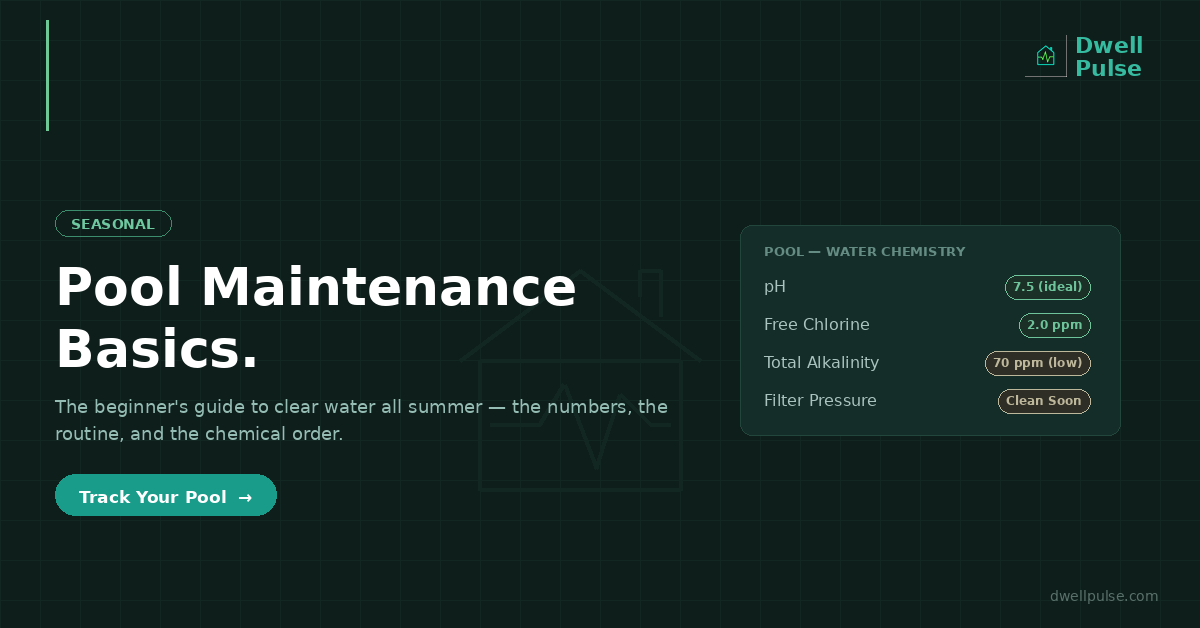
A backyard pool is one of summer’s great pleasures — right up until the water turns cloudy or green and you’re standing at the pool store holding a water sample and a credit card, hoping someone can tell you what went wrong. The good news: keeping a pool crystal clear isn’t complicated. It comes down to understanding a handful of chemistry numbers and following a simple, consistent routine.
Here’s the beginner’s guide: the levels that matter, how often to test, the daily/weekly/monthly tasks, and the one mistake — adding chemicals in the wrong order — that trips up almost every new pool owner.
The Only Chemistry Numbers You Really Need
Clear, safe pool water depends on keeping a few chemical levels in range. These are the targets that show up consistently across pool-care sources [1][2]:
- pH: 7.4 to 7.6 (7.5 is the sweet spot). This is the most important number — it measures how acidic or basic the water is. Below 7.2, water irritates eyes and corrodes metal; above 7.8, chlorine stops working effectively.
- Free chlorine: 1 to 3 ppm. This is your sanitizer — it kills bacteria and algae. Never let it hit zero.
- Total alkalinity: 80 to 120 ppm. This acts as a buffer that keeps pH from swinging wildly. Get this right first — if alkalinity is off, your pH will bounce around no matter what you do.
- Calcium hardness: 200 to 400 ppm. Too low corrodes surfaces and equipment; too high causes scale buildup.
- Cyanuric acid (stabilizer): 30 to 50 ppm for outdoor pools. This protects chlorine from being destroyed by sunlight — without it, the sun can burn off most of your chlorine within an hour [2].
You don’t need to memorize the chemistry. You need to keep these five numbers in their ranges, and the water stays clear.
How Often Should You Test Your Pool Water?
Testing is cheap insurance against expensive problems. The cadence depends on the season and use [3]:
- Peak summer / heavy use: test chlorine and pH 2 to 3 times per week. During a heat wave or after a pool party, more often.
- Normal conditions: at least once a week for chlorine and pH.
- Total alkalinity, calcium hardness, and stabilizer: about once a month — these change more slowly.
- After any big event: heavy rain, heavy swimmer load, or a storm all throw off your chemistry, so test afterward regardless of schedule [1].
Test strips are inexpensive (around $25 for 100) and fine for routine checks; a liquid test kit is more accurate for dialing things in; and most pool stores will run a free detailed test if you bring a water sample [3].
The Routine: Daily, Weekly, Monthly
Consistent small efforts beat occasional big rescues. Here’s the rhythm [4]:
Daily (a few minutes):
- Skim leaves and debris off the surface
- Check that the water level is adequate and the pump is running
Weekly:
- Test and adjust chemistry (2–3x in peak season)
- Brush the walls, steps, and any spots with poor circulation
- Vacuum the pool floor
- Empty the skimmer and pump baskets
- Check the filter pressure
Monthly (or as needed):
- Test and adjust alkalinity, calcium hardness, and stabilizer
- Deep-clean or backwash the filter per its type
- Shock the pool (more below)
What Is “Shocking” a Pool?
Shocking means adding a high dose of chlorine (or a non-chlorine oxidizer) to blast out the contaminants that regular chlorine leaves behind — sweat, sunscreen, organic debris, and the compounds that cause that strong “chlorine smell” [1]. Counterintuitively, a strong chlorine odor usually means you have too little effective chlorine, not too much — it’s a sign you need to shock.
Shock the pool periodically as part of your routine, and always after heavy use, heavy rain, or any time the water looks cloudy or dull. Even saltwater pools need occasional shocking.
The Mistake Everyone Makes: Chemical Order
Here’s the single most useful thing for a beginner to know. Pool chemicals interact, and adding them in the wrong order — or too close together — causes problems and wastes product. Follow this sequence, waiting between each step [5]:
- Total alkalinity first. Wait 1–2 hours with the pump running.
- pH second. Wait at least 30 minutes.
- Calcium hardness third. Wait 1 hour.
- Cyanuric acid (stabilizer) if needed. Allow 48 hours to circulate before retesting.
- Chlorine or shock last.
The reason alkalinity comes first is that it buffers pH — if you chase pH before alkalinity is right, you’ll fight it endlessly. Get the order right and pool chemistry becomes genuinely simple. Get it wrong and you’ll spend the summer overcorrecting.
Also important: test often, add chemicals sparingly. Overtreating is a common, costly beginner habit that causes its own clarity and safety problems. Small, measured adjustments beat big corrective doses [2].
Don’t Forget the Equipment
Chemistry gets the attention, but your pool’s physical systems do the quiet work. The pump circulates water (run it several hours a day — circulation spreads chemicals and prevents stagnation), the filter removes debris, and both need periodic cleaning. Keep the skimmer and pump baskets clear, watch the filter pressure gauge (a rising reading means it’s time to clean or backwash), and note your equipment’s age — pumps, filters, and heaters all have finite lifespans and are significant replacement costs when they fail.
Why Tracking Your Pool Pays Off
A pool is a system with a recurring rhythm — daily skims, weekly chemistry, monthly deep tasks, seasonal opening and closing — plus expensive equipment (pump, filter, heater, liner) that ages on its own timeline. Miss the routine and you get a green pool and a costly rescue; ignore the equipment and a pump failure blindsides your budget. The pool owners who avoid both are the ones who keep a schedule and a record: what the chemistry read, when they last shocked it, when the filter was cleaned, and how old the equipment is.
How DwellPulse Helps
DwellPulse lets you track your pool as one of your home’s systems — the pump, filter, heater, and liner all logged with their install dates, warranties, expected lifespans, and replacement costs, so an equipment failure never catches you off guard. Set recurring reminders for the whole rhythm: weekly chemistry testing in peak season, monthly filter cleaning, seasonal opening and closing. Log your maintenance and store equipment manuals and service invoices in one place. And because DwellPulse forecasts big-ticket replacements, you’ll see the pump or heater replacement coming years ahead instead of during a July heat wave. A clear pool all summer comes down to consistency — and DwellPulse is how you keep the rhythm without keeping it all in your head.
Track your pool and its equipment →
Sources: [1] Angi, “Pool Maintenance 101 for New Pool Owners,” April 2026, on weekly chlorine/pH/alkalinity testing, shocking after heavy rain and use, and the strong-chlorine-smell indicator. [2] AquaDoc, “Pool Chemicals for Beginners,” June 2026, and Litehouse Pools & Spas, “Pool Water Testing 101,” March 2026, on target ranges (pH 7.4–7.6, chlorine 1–3 ppm, alkalinity 80–120 ppm, calcium 200–400 ppm, stabilizer 30–50 ppm), the sunlight/stabilizer relationship, and testing often but treating sparingly. [3] Leisure Pools USA, “Pool Maintenance 101,” June 2026, In The Swim, “Beginner’s Guide to Pool Water Testing,” and Litehouse, on testing 2–3x weekly in peak season, monthly for alkalinity/calcium, and test-strip vs. liquid-kit vs. pro-store options. [4] In The Swim, “Pool Maintenance Schedule for Beginners,” and Angi, on the daily skim / weekly brush-vacuum-test / monthly routine. [5] AquaDoc, “Pool Chemicals for Beginners,” on the chemical-addition order (alkalinity → pH → calcium → stabilizer → chlorine) and required wait times.
* This article was written with the assistance of AI tools. All content is reviewed and edited by Josh Standeven.
Ready to take control of your home?
DwellPulse is free to start — track maintenance, projects, appliances, and your garden all in one place.
Start Free Today →