Repair or Replace? The 50% Rule That Tells You When to Cut Your Losses on an Appliance
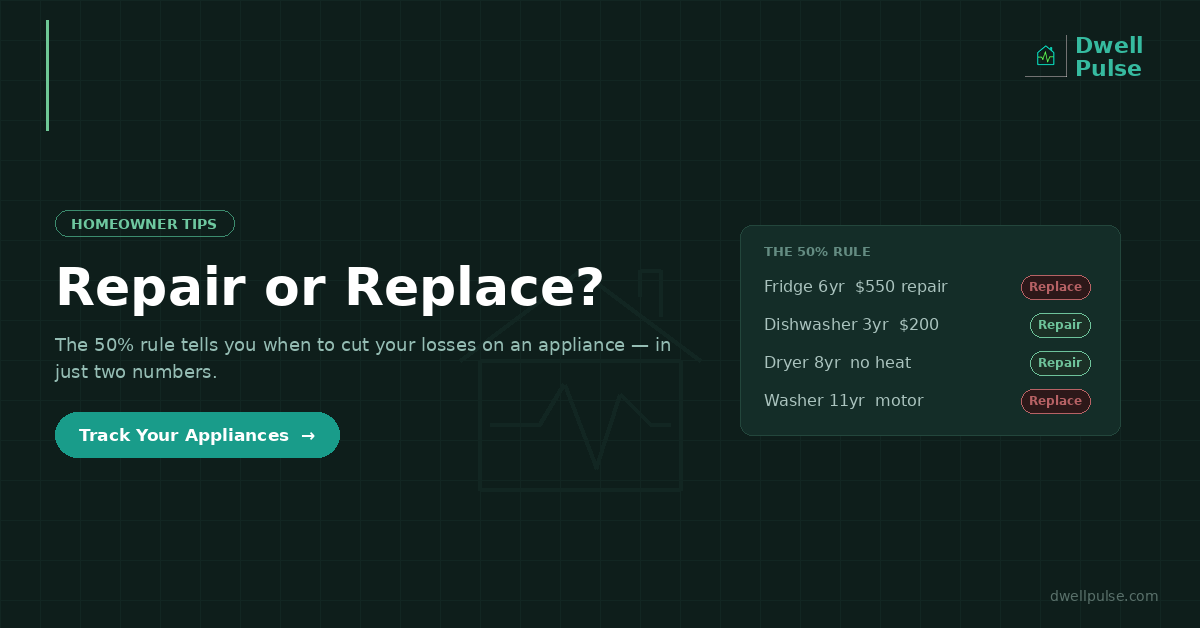
Your refrigerator stopped cooling overnight. The repair tech diagnoses a failed compressor and quotes you $550. A comparable new fridge runs about $900. Do you spend the $550 and hope for a few more years, or put it toward something new?
This is one of the most common — and most stressful — decisions in home ownership, and most people make it on gut feeling at the worst possible moment, standing in a kitchen with a cooler full of melting groceries. There’s a better way. Appliance repair technicians use a simple framework called the 50% rule, and once you know it, the repair-or-replace question usually answers itself.
The 50% Rule, Explained
The rule has two conditions, and the key is that both need to be true for replacement to make sense [1]:
- The repair costs more than 50% of a comparable new appliance, and
- The appliance is past the midpoint of its expected lifespan
If both are true, replace it. If only one — or neither — is true, repair almost always wins financially.
Let’s run the refrigerator example through it. A new comparable model is $900, so 50% of replacement cost is $450. The repair quote is $550 — above the threshold. And the fridge is 6 years old against a typical 12-year lifespan, so it’s exactly at its midpoint. Both conditions are met. Replace it [1].
Now a counter-example: a 3-year-old dishwasher with a failed drain pump. The repair is $200; a new comparable unit is $650, so the 50% threshold is $325. The repair ($200) is well under that, and at 3 years the dishwasher is only about 30% through its expected life. Neither condition for replacement is met. Repair it — easily [1].
Knowing the Midpoint: Typical Appliance Lifespans
The rule only works if you know how long the appliance was supposed to last. These are the widely accepted averages for standard mid-range models [2]:
- Refrigerators: 10–15 years (often cited as 13–17 for the unit itself)
- Washing machines: 10–12 years
- Dryers: 10–13 years
- Dishwashers: 9–12 years
- Gas ranges/ovens: 15–20 years
- Electric ranges: 13–15 years
- Microwaves: 9–10 years
- Water heaters (tank): 8–12 years
- Garbage disposals: 8–12 years
A few important adjustments. Premium brands like Sub-Zero, Wolf, and Miele are built to last 20 years or more, with better long-term parts availability — so a $600 repair on a 10-year-old high-end unit can make sense when the same repair on a standard brand wouldn’t [1]. And climate matters: in hot, humid regions, appliances degrade faster, knocking an estimated 1–3 years off the typical lifespan for most categories [3].
When the Math Isn’t the Whole Story
The 50% rule is a financial framework, but three factors can override it.
Safety always wins. An appliance with faulty wiring, a gas leak, or any failure that poses a fire or carbon monoxide risk should be replaced regardless of what the math says. Don’t repair your way around a safety hazard to save a few hundred dollars [4].
Pattern failures signal the end. If an appliance has needed multiple repairs in a short window, or a repair fixes one thing only for two more to fail within months, you’re past the point of throwing good money after bad. Repeated control-board failures on the same unit, in particular, usually indicate a deeper electrical problem [5]. Replace it.
Energy efficiency adds up. Newer appliances — especially refrigerators — often use meaningfully less electricity, which can shave $100–$200 a year off utility bills [4]. On a borderline 50%-rule call, the efficiency savings of a new unit can tip the decision toward replacement even when the repair is technically the cheaper upfront option.
The Repair-Friendly and Replace-Friendly Appliances
Some appliances are almost always worth repairing; others tip toward replacement faster.
Lean toward repair: Dryers are mechanically simple — the most common failure (not heating) is usually a $20–$50 heating element or thermal fuse, a great-value repair on a $400–$1,000 machine [5]. Gas ranges are workhorses; igniters, bake elements, and sensors are inexpensive fixes on units that last 15–20 years [5]. Washing machines under 10 years old with common failures (drain pump, lid switch, inlet valve) are typically $100–$220 repairs that are strongly worth doing [5].
Apply the rule more carefully: Dishwashers reach end-of-life faster (9–12 years) and budget models can be replaced for $350–$500, so a control-board or motor failure on a 10-year-old unit often favors replacement [5]. Refrigerator compressor failures are the classic replacement trigger — but a non-compressor fix (defrost heater, evaporator fan) on a 10-year-old fridge with years of life left is usually worth repairing [5].
One Modern Wrinkle: Smart Appliances Fail More Often
If you’re shopping for a replacement, here’s a finding worth knowing. JD Power’s inaugural 2025 U.S. Appliance Reliability study, based on over 12,000 responses, found that smart appliances with active Wi-Fi features experienced about 92 problems per 100 appliances — nearly 50% more than non-connected models [6]. The connectivity features that sound appealing on the showroom floor are also more things that can break. It’s worth weighing whether you actually need the smart features, or whether a simpler, more reliable model serves you better.
Why You Can’t Apply the Rule Without Records
Here’s the catch that trips up most homeowners: the 50% rule depends on knowing how old the appliance actually is. Standing in the kitchen with a dead fridge, can you say with confidence whether it’s 6 years old or 11? That single fact flips the decision — a $550 repair on a 6-year-old fridge is borderline, but on an 11-year-old fridge it’s an easy replace.
Most people genuinely don’t know. The purchase date is on a receipt that’s long gone, and the manufacture date is buried in a serial number nobody decoded. So the decision gets made on a guess — and a guess is how you end up putting $550 into a fridge that fails again 14 months later.
How DwellPulse Helps
DwellPulse makes the repair-or-replace decision a matter of looking it up instead of guessing. When you add an appliance, you record its purchase or install date, make, model, and expected lifespan — so the moment something breaks, you know exactly where that appliance sits on its life curve. DwellPulse even shows a lifespan indicator for each appliance, so you can see at a glance whether a unit is in its early years or living on borrowed time. Pair that with a quick repair quote and the 50% rule answers itself in under a minute, with no guesswork and no melting groceries. And because your purchase documentation and service history live with each appliance, you’ll also know whether it’s still under warranty before you pay for a repair you didn’t need to.
Track your appliances the smart way →
Sources: [1] Total Repair Pros, “The 50/50 Rule for Appliance Repair vs Replacement,” January 2026, including the worked refrigerator and dishwasher examples and premium-brand exceptions. [2] Appliance Repair Carrollton GA, “Repair vs Replace Appliance Guide 2026,” and House Digest, “The 50% Rule,” November 2025, for appliance lifespan ranges. [3] Bozmanfix, “Appliance Repair Statistics 2026,” citing IBISWorld data on humidity/heat reducing appliance lifespan by 1–3 years in the Southeast. [4] A1 Appliance Repair, “When to Repair vs Replace Appliances,” February 2026, on safety, energy efficiency, and $100–$200 annual savings from newer units. [5] Appliance Repair Carrollton GA, “Repair vs Replace Appliance Guide 2026,” for appliance-by-appliance repair-cost ranges and pattern-failure guidance. [6] JD Power, “U.S. Appliance Reliability & Service Study,” September 2025 (12,755 responses, June–July 2025), via Bozmanfix, finding connected appliances average 92 problems per 100 units vs. non-connected.
* This article was written with the assistance of AI tools. All content is reviewed and edited by Josh Standeven.
Ready to take control of your home?
DwellPulse is free to start — track maintenance, projects, appliances, and your garden all in one place.
Start Free Today →