Summer Garden Care: How to Water, Beat Pests, and Harvest at the Right Time
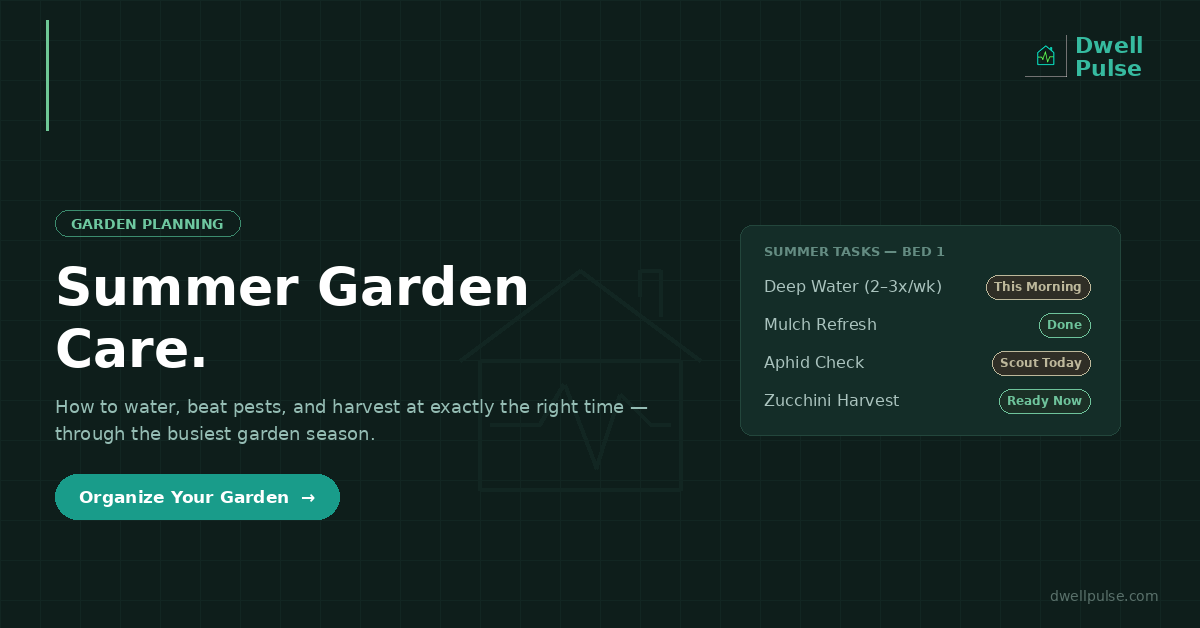
Summer is the payoff season for a vegetable garden — and also the one where the most gardens quietly fail. The heat that drives explosive growth also dries the soil out fast, invites a wave of pests, and creates a narrow window where produce goes from “not ready” to “past its prime” in a matter of days. Get the summer routine right and you’ll harvest all season. Get it wrong and July is where the garden gives up.
Here’s what actually matters in the height of summer: watering correctly, staying ahead of pests, and harvesting at the right moment.
How Much Should You Water a Vegetable Garden in Summer?
The widely cited guideline is about 1 inch of water per week, from rain and irrigation combined — but the more important principle is how you deliver it. Most vegetables do best with deep, infrequent watering: a long soak 1 to 3 times per week rather than a light sprinkle every day [1].
The reason comes down to roots. Deep watering soaks moisture 6 to 12 inches into the soil, and roots follow it downward, building a deep, drought-resilient root system. Shallow daily watering keeps only the top inch or two moist, training roots to stay near the surface where they’re far more vulnerable to heat and dry spells [2]. Deep and infrequent beats shallow and frequent almost every time.
In summer specifically: water deeply 2 to 3 times per week for in-ground beds. Raised beds and containers drain and dry faster and often need 3 to 5 times per week — or even daily above 85°F, especially for shallow-rooted leafy greens [1][3].
When Is the Best Time to Water?
Early morning, between about 5 and 9 a.m. [4]. Morning watering has three advantages: less water is lost to evaporation before plants can use it, foliage dries before evening (which suppresses the fungal diseases that thrive on wet overnight leaves), and plants enter the heat of the day fully hydrated.
Evening watering is an acceptable fallback if morning isn’t possible, but try to keep water at the soil and off the leaves — a soaker hose or drip line is ideal for this. And don’t let a wilting plant suffer just because it’s midday: the “water droplets burn leaves in sun” idea is a myth, so if plants are visibly stressed in extreme heat, water them [5].
The Single Best Thing You Can Do: Mulch
If you do only one thing for your summer garden, mulch it. A 2 to 3 inch layer of organic mulch — straw, shredded leaves, or untreated grass clippings — dramatically reduces evaporation, can cut water loss by up to 50%, regulates soil temperature to keep roots cooler, and suppresses the weeds that compete for that precious moisture [6].
One rule: keep mulch a couple of inches away from plant stems to prevent rot and discourage slugs.
How Do You Know When to Water? (The Finger Test)
Skip the fixed schedule and read the soil. Insert your finger 1 to 2 inches into the ground (pull back the mulch first). If it feels dry at that depth, it’s time to water. If it’s still moist, wait [2].
This matters because overwatering and underwatering look nearly identical — both cause wilting and yellowing. The counterintuitive sign is a plant wilting in wet soil, which usually means overwatering or root rot, not drought. Always check the soil before you water; the two problems have opposite fixes [7].
How Do You Keep Pests Out of a Summer Garden?
Summer is peak pest season. The most effective approach is prevention and early detection, not waiting until damage is done.
- Scout regularly. Walk the garden every few days and check the undersides of leaves, where aphids, mites, and eggs hide. Catching an infestation early is the difference between a quick fix and a lost crop.
- Blast aphids with water. A strong spray from the hose knocks aphids off plants and is often enough on its own for a minor infestation.
- Encourage beneficial insects. Ladybugs, lacewings, and parasitic wasps eat the pests you don’t want. Flowering herbs and companion plants nearby draw them in.
- Hand-pick larger pests. Tomato hornworms and squash bugs can be removed by hand — unpleasant, but highly effective and chemical-free.
- Keep foliage dry and airflow open. Morning watering, proper spacing, and pruning crowded growth reduce the humid conditions that fungal diseases and many pests love.
- Use row covers on vulnerable crops. Lightweight covers physically block many pests from reaching brassicas and young plants.
When Should You Harvest? Timing Is Everything
Harvesting at the right moment is what separates a good garden from a great one — and most beginners wait too long. As a general rule, frequent harvesting encourages more production: picking beans, cucumbers, zucchini, and tomatoes regularly signals the plant to keep producing, while letting fruit over-ripen on the vine tells it to stop.
Quick timing cues for common summer crops:
- Tomatoes: pick when fully colored but still firm; they’ll finish ripening on the counter.
- Zucchini and summer squash: harvest young and small (6–8 inches) — they turn to woody baseballs fast if you blink.
- Cucumbers: pick firm and medium-sized before they yellow.
- Green beans: harvest when pods are firm and crisp, before the seeds bulge.
- Peppers: can be picked green or left to ripen to red/yellow for more sweetness.
- Leafy greens: harvest outer leaves in the cool of the morning, before the day’s heat makes them wilt and turn bitter.
The trick is that these windows are short and they overlap — which is exactly why keeping track of what you planted and when it’s due matters so much in the busy summer months.
How DwellPulse Helps
Summer is when a garden has the most going on at once — multiple beds, multiple crops, each on its own watering, feeding, and harvest timeline. DwellPulse keeps it organized so nothing slips. Track each planted crop through its growth stages and see your next harvest date at a glance, so you catch the zucchini before it becomes a baseball. Set recurring garden tasks — watering, mulching, weeding, pest checks, harvesting — tied to specific beds, with reminders so the routine stays on track through the busiest stretch of the season. And because DwellPulse integrates with the National Weather Service, weather-dependent tasks factor in what’s actually coming — so you’re not watering the morning before a downpour. Log your harvests as they come in, and you build a season-over-season record of what produced well and when, making next summer’s garden smarter than this one.
Sources: [1] University of Minnesota Extension, “Watering the vegetable garden,” and The Old Farmer’s Almanac, “When to Water Your Vegetable Garden,” June 2026, on the 1 inch/week guideline and deep watering 2–3 times weekly. [2] Reencle, “How Often Should I Water My Vegetable Garden,” March 2026, and Chicago Botanic Garden, “How to Water Wisely This Summer,” on deep vs. shallow watering and root depth (6–12 inches). [3] RASNetwork, “How Often Should You Water Your Vegetable Garden,” August 2025, on raised beds needing 3–5 times weekly and daily above 85°F. [4] Thrive Lot, “Seasonal Watering Guide for Vegetable Gardens,” citing Iowa State’s Richard Jauron on the 5–9 a.m. optimal window. [5] Reencle, on the midday-watering leaf-burn myth and watering visibly stressed plants. [6] Thrive Lot and University of Minnesota Extension, on 2–3 inch organic mulch reducing water loss by up to 50%. [7] Reencle and homesteadingfamily.com, “Should I Water My Garden Every Day,” on distinguishing overwatering from underwatering via the soil-check method.
* This article was written with the assistance of AI tools. All content is reviewed and edited by Josh Standeven.
Ready to take control of your home?
DwellPulse is free to start — track maintenance, projects, appliances, and your garden all in one place.
Start Free Today →