The First-Year Homeowner Mistakes That Cost the Most — And How to Avoid Them
The keys are in your hand. The boxes are stacked in the living room. For the first time, every decision about this house is yours — which is exciting until you realize that every problem is now yours too.
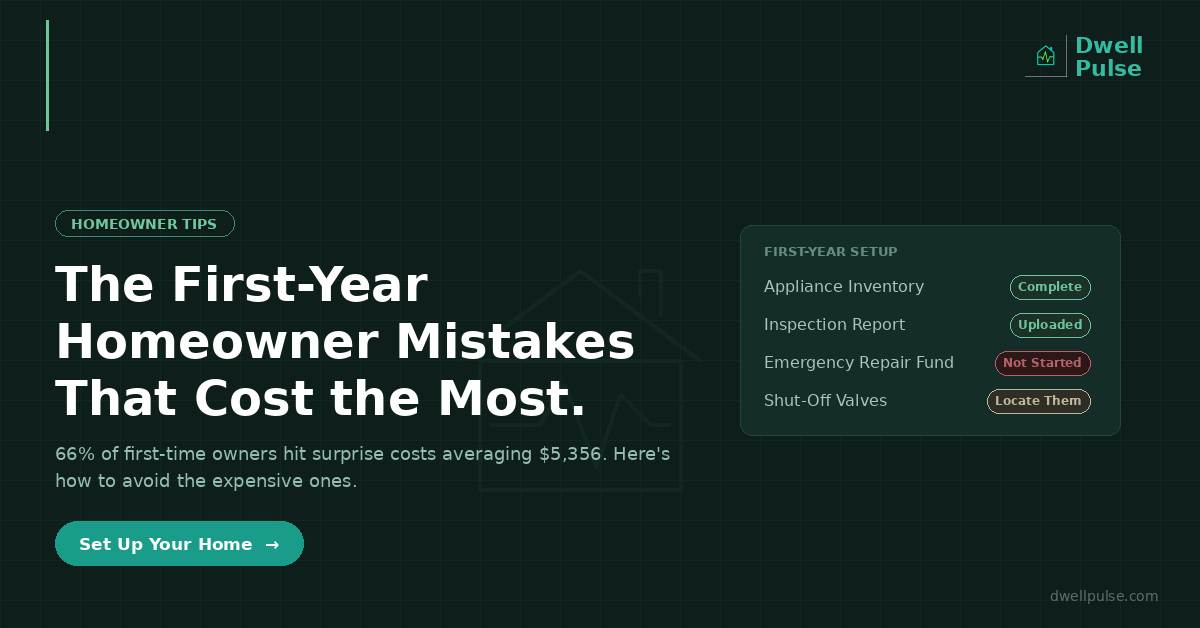
The first year of homeownership is when the gap between expectation and reality is widest. According to a 2025 American Home Shield survey of 1,001 homeowners, 46% said they didn’t understand the true cost of homeownership before purchasing, and 56% had no budget for the repairs that inevitably pop up in the first year [1]. A separate survey found that 66% of first-time homeowners faced unexpected home issues after buying, at an average cost of $5,356 [2]. Bankrate’s 2025 Homeowner Regrets Survey found that the single most common regret — cited by 42% of homeowners with any misgivings — was that maintenance and hidden costs were more expensive than expected [3].
These aren’t bad luck. They’re predictable, repeatable mistakes that nearly every first-year homeowner makes. Here are the most expensive ones, and how to sidestep each.
Mistake 1: No Emergency Repair Fund
This is the foundational error that makes every other problem worse. More than half of homeowners (58%) have nothing saved for emergency repairs, and nearly a third (30%) have gone into debt completing home projects [4]. When the water heater fails in month three, a homeowner with no repair fund puts $1,800 on a credit card at 24% APR — turning a $1,800 problem into a $2,200 problem.
How to avoid it: Build a home maintenance fund before you need it. A common rule of thumb is to set aside 1% to 2% of your home’s value annually for maintenance and repairs — on a $400,000 home, that’s $4,000 to $8,000 a year, or roughly $330 to $660 per month. Automate a transfer into a dedicated savings account each payday so the money is there when the water heater isn’t.
Mistake 2: Not Knowing What You Own (or How Old It Is)
New homeowners rarely know the age of their roof, the model of their HVAC system, when the water heater was installed, or whether any of it is still under warranty. This matters enormously: an appliance that’s one year from the end of its service life needs to be budgeted for now, not discovered when it fails.
How to avoid it: In your first month, do a full inventory. Walk the house and record every major system and appliance — make, model, serial number, and approximate age (the manufacture date is often on a label, and the serial number can usually be decoded online). Photograph the data plates. This becomes the foundation of every future maintenance and budgeting decision you make.
Mistake 3: Skipping the Inspection (or Ignoring the Report)
Roughly 17% of buyers skip the home inspection entirely, and buyers earning under $50,000 are the most likely to do so [2]. But the more common version of this mistake is getting the inspection, using it to negotiate, and then never opening the report again — even though it’s a detailed roadmap of everything that will need attention over the next decade.
How to avoid it: Never waive the inspection, no matter how competitive the market. And after closing, turn the report into an action plan. Every “monitor this,” “replace within X years,” and “have a specialist evaluate” finding is a future task or a budget line item. The inspector already told you what’s coming — the mistake is filing it away and forgetting.
Mistake 4: Deferring Maintenance to Save Money
The most expensive thing a new homeowner can do is nothing. Skipping the $150 HVAC tune-up, postponing the $200 gutter cleaning, ignoring the slow drip under the bathroom sink — each feels like a saving in the moment. Each is a future repair compounding in the walls. The average deferred repair now costs more than $5,600 once it becomes urgent, and 85% of homeowners spent money on an unplanned repair in 2025 [4].
How to avoid it: Treat routine maintenance as non-negotiable, not discretionary. The math is overwhelming: a $150 tune-up prevents a $4,000 compressor failure; a $200 gutter cleaning prevents thousands in foundation water damage. Build a recurring maintenance schedule in your first month and stick to it.
Mistake 5: Throwing Away the Paperwork
Every appliance comes with a manual and a warranty. Every contractor leaves a receipt. Every improvement generates documentation that affects your warranty coverage, your insurance claims, your tax cost basis, and your eventual resale value. New homeowners, overwhelmed by boxes and to-do lists, toss it all into a drawer — or the trash.
How to avoid it: Start a document system on day one. Upload manuals, warranties, receipts, the inspection report, and closing documents to a single organized place — linked to the specific appliance or project each one relates to. The receipt you save in month one is the warranty claim you win in year four.
Mistake 6: Over-Renovating Too Soon
The urge to make the new house “yours” immediately leads many first-year owners into renovation budgets they can’t sustain. A striking 70% of homeowners went over budget on their last renovation, 44% by at least $5,000, and 36% struggled to pay their credit card bill after funding a remodel [4]. Renovating before you understand the house — how it lives, what actually needs fixing, how the light moves through the rooms across seasons — leads to expensive decisions you’d make differently with a year of experience.
How to avoid it: Live in the house for a full year before any major non-essential renovation. Fix what’s broken or unsafe immediately. But hold off on the cosmetic remodels until you understand how you actually use the space. The kitchen you’d design in month one is rarely the kitchen you’d design in month twelve.
Mistake 7: Not Knowing Where the Shut-Offs Are
When a pipe bursts at 11 p.m., the difference between $200 in damage and $14,000 is whether you can find and operate your main water shut-off in under two minutes. Most new homeowners have never located theirs — or the gas shut-off, or the main breaker.
How to avoid it: In your first week, find and test the main water shut-off, the electrical panel and main breaker, the gas shut-off, and the individual shut-offs under every sink and toilet. Label them. Make sure everyone in the household knows where they are. This is a 30-minute task that can save you a five-figure repair.
The Common Thread
Look closely and every one of these mistakes shares a root cause: a lack of organized information about the home. You can’t budget for a water heater you don’t know is 11 years old. You can’t win a warranty claim with a receipt you threw away. You can’t follow the inspection report’s recommendations if it’s lost in a drawer. You can’t shut off the water if you’ve never found the valve.
The first-year homeowners who avoid the expensive mistakes aren’t smarter or richer. They’re organized — they treat the house as a system to be documented and managed, not a collection of problems to be handled as they arise.
How DwellPulse Helps
DwellPulse is built to be the first thing a new homeowner sets up. Add your property and inventory every major system and appliance — make, model, serial number, age, and warranty status — so you know exactly what you own and what’s coming. Upload your inspection report, manuals, warranties, and closing documents to the Documents vault, organized and searchable. Turn inspection findings into recurring maintenance reminders so nothing gets deferred into a crisis. Track shut-off valve locations and emergency information so anyone in the household can act fast. And use the Expense Forecast to project the big-ticket replacements — roof, HVAC, water heater — years before they hit, so you’re funding the maintenance account instead of the credit card.
The mistakes that cost first-year homeowners thousands are all preventable with one thing: a system that remembers what you can’t. Start it on day one.
Set up your home the right way →
Sources: [1] American Home Shield, “The True Cost of Homeownership in 2025,” March 2025 survey of 1,001 homeowners, finding 46% didn’t understand true costs and 56% had no repair budget. [2] The MortgagePoint, “Let the Buyer Beware,” April 2025, citing 66% of first-time homeowners faced unexpected issues averaging $5,356, and 17% skipped inspection. [3] Bankrate, “2025 Homeowner Regrets Survey,” via CNBC and The MortgagePoint, June 2025, 42% cited maintenance/hidden costs as top regret. [4] Clever Offers, “Home Renovation Trends 2026,” February 2026, citing 58% have nothing saved for emergency repairs, 30% went into debt, 85% had an unplanned repair in 2025, 70% over budget. [5] BAM, “Remodeling Gone Wrong,” December 2025, citing 78% over budget and 36% struggled with credit card bills post-remodel. Average deferred repair cost ($5,600) via Pearl Home Maintenance Cost Report, February 2026.
*Writing assisted by AI
Ready to take control of your home?
DwellPulse is free to start — track maintenance, projects, appliances, and your garden all in one place.
Start Free Today →