The Hidden Leak Problem: Why 1 in 60 Homes Files a Water Damage Claim Every Year
A damp spot on the ceiling. A musty smell in the hallway closet. A water bill that’s suddenly 20% higher for no apparent reason. These are the quiet early signals of the single most common non-weather home insurance claim in the country — and most homeowners miss them until the damage is measured in five figures.
Water damage is the second most frequent home insurance claim in the United States, behind only wind and hail. Industry data reports that roughly 1 in 60 insured homes files a water damage or freezing claim each year, with the average payout around $13,954 per claim [1]. The part nobody tells you: a huge share of that damage started as a small leak that nobody noticed for weeks.
Where Hidden Leaks Actually Start
Most water damage in American homes doesn’t come from dramatic storms. It comes from slow plumbing failures — leaks behind walls, under slabs, inside ceilings, and around appliances — that quietly soak drywall, subflooring, and framing long before anyone sees a drop of water on the floor.
The usual suspects are predictable:
- Supply lines to washing machines, dishwashers, and refrigerators — rubber hoses become brittle and split, often when nobody’s home
- Water heater tanks — corrosion from the inside causes slow seepage, then a sudden rupture
- Toilet supply valves and wax rings — leak into subfloors under the toilet, hidden from view
- Pinhole leaks in copper supply lines — common in homes built between the 1960s and 1980s, caused by internal corrosion
- Slab leaks — pipes embedded in the concrete foundation that leak sideways into the soil or up through the slab
A leak of just one drip per second wastes over 3,000 gallons per year. More importantly, sustained moisture behind walls or under floors creates ideal conditions for mold growth, wood rot, and structural damage — and mold remediation alone can run into the thousands [2].
The Warning Signs Most Homeowners Ignore
Hidden leaks don’t announce themselves. They leave breadcrumbs. If you learn to recognize them, you can catch a $200 plumbing repair before it becomes a $10,000 restoration job.
The water bill test. Compare this month’s water bill to the same month last year. An unexplained increase of 20% or more almost always means a leak somewhere in the system [3]. You can confirm it with the meter test: turn off every water-using fixture in the house (including ice makers and irrigation), write down the meter reading, wait two hours without using any water, and check again. If the number moved, you have a leak.
Damp or discolored spots on walls, ceilings, or floors — especially bubbling paint, warped baseboards, or yellow-brown ceiling stains — are late-stage signs. The leak has already been going for a while. Musty or mildewy smells in a closet, basement, or specific room often precede any visible damage. Mold spores settle and start forming colonies in warm, damp places before you can see them.
The sound of running water when nothing is turned on — particularly faint hissing or trickling inside a wall — is a plumbing emergency hiding in plain sight.
Warm spots on the floor (if a hot water supply line is leaking under the slab), unexplained cracks in drywall, or mold or mildew along baseboards all point toward a slab leak.
Why Catching It Early Saves Thousands
The cost gap between “caught early” and “caught late” on a water leak is enormous. A simple, accessible leak repair typically costs $150 to $350 [4]. A leak hidden inside a wall, ceiling, or under flooring runs $500 to $2,500 once you factor in leak detection, accessing the pipe, making the repair, and restoring the finished surfaces [5]. Water damage restoration itself averages $1,300 to $6,000 and can exceed $15,000 for significant damage [6].
And here’s the part that really stings: homeowners insurance typically covers sudden and accidental water damage — a pipe that bursts without warning. It often denies claims for gradual damage, like a slow leak behind a wall that went unaddressed for months [7]. If an adjuster can argue the damage resulted from “lack of maintenance,” your claim may be reduced or denied entirely.
Documentation is the difference between a denied claim and a covered one.
Building a Simple Leak Prevention Routine
You don’t need to become a plumber. You need a handful of habits.
Quarterly visual check (5 minutes). Look under every sink, behind every toilet, and around the water heater. You’re looking for moisture, corrosion on fittings, and any discoloration on the cabinet floor.
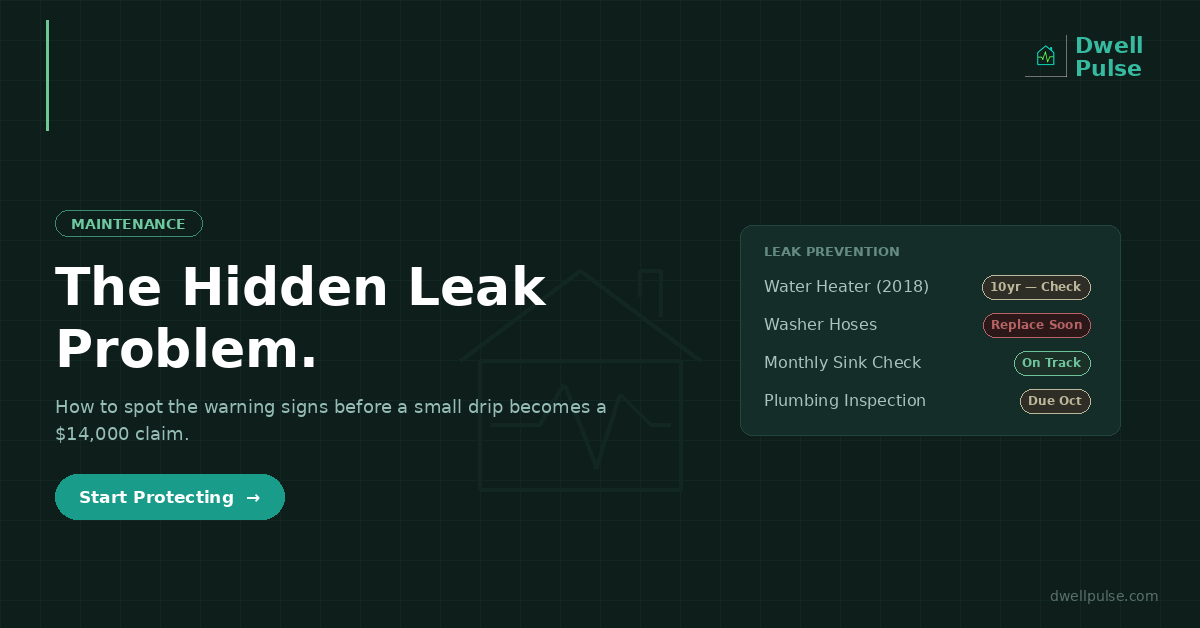
Check washing machine hoses. Rubber supply hoses are rated for about five years. Replace them with stainless steel braided hoses — they’re under $20 a pair and far less likely to fail catastrophically.
Know the age of your water heater. Track the install date and note the warranty expiration. Tank heaters typically last 8 to 12 years; after year 10, you’re on borrowed time.
Schedule a plumbing inspection every few years (little overkill, but helpful). A licensed plumber can pressure-test the system, check water pressure (anything over 80 PSI stresses the pipes), and identify failing fittings before they flood your kitchen.
Locate your main water shut-off valve and test it. If it’s seized from not being used in a decade, you’ll discover that during the emergency — which is the wrong time.
Store plumbing invoice. When an adjuster asks whether the water heater was maintained, you want to be able to pull up the service history in under a minute.
How DwellPulse Helps
DwellPulse gives homeowners a single place to track every major plumbing asset in the house — water heater, washing machine, dishwasher, sump pump, and all major appliances — along with install dates, warranty expirations, and service history. Set recurring reminders for monthly leak checks, annual hose inspections, and biennial plumbing reviews. Upload your plumbing service invoices to the Documents vault so you can prove maintenance history when an insurance claim depends on it. The goal isn’t just organization — it’s catching a small leak before it becomes a $13,954 claim.
[
Start protecting your home from hidden leaks →](app.dwellpulse.com)
Sources: [1] Insurance Information Institute via industry reports, water damage and freezing claims, average payout $13,954 and frequency 1 in 60 insured homes. [2] First Alert, “How to Detect Water Leaks,” 2025. [3] Isley Plumbing, “Water Leak Detection,” March 2026. [4] Robert Kurek, “How Expensive Is It to Fix a Water Leak,” November 2025. [5] Suburban Plumbing Experts, “Cost to Fix a Leaking Pipe or Faucet,” February 2026. [6] ConsumerAffairs, “Water Damage Insurance Claims Statistics,” HomeAdvisor data. [7] Guardian Service, “Water Damage Statistics,” July 2025.
*Writing Assisted by AI
Ready to take control of your home?
DwellPulse is free to start — track maintenance, projects, appliances, and your garden all in one place.
Start Free Today →