The Quarterly Home Maintenance Checklist That Saves You Thousands
The average American homeowner spent $8,808 on home maintenance in 2025, according to Bankrate’s annual survey [1]. That number includes routine upkeep, unexpected repairs, and replacements — but the split between those categories is entirely within your control.
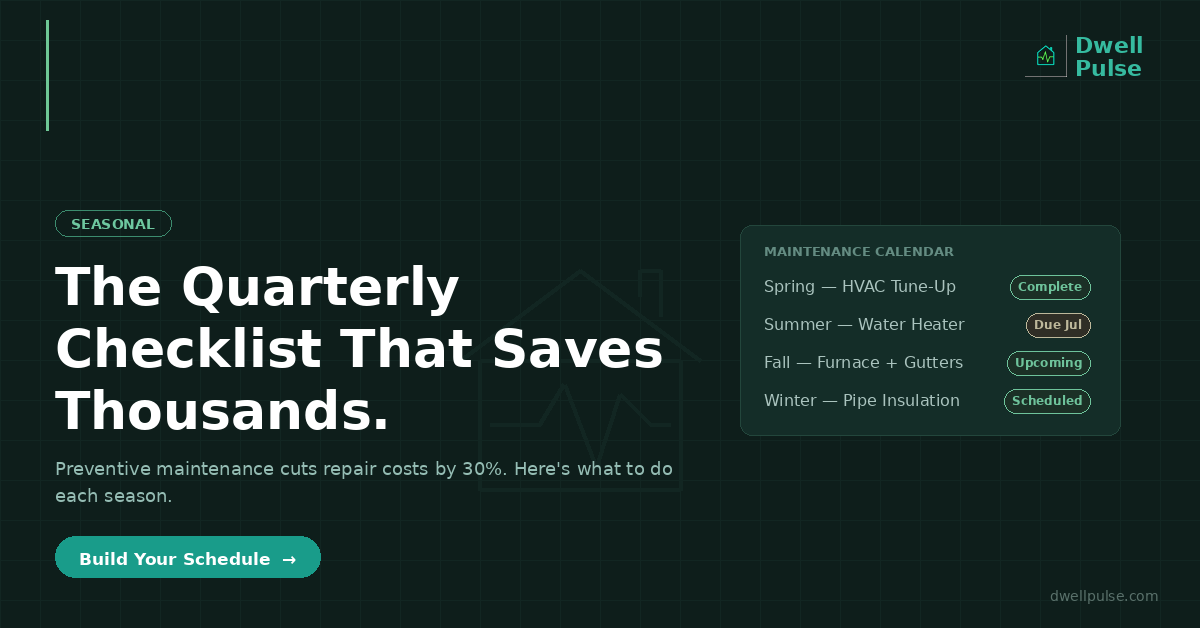
Industry research indicates that preventive maintenance can reduce overall repair costs by approximately 30% [2]. The average deferred repair — the thing you put off until it became urgent — now costs more than $5,600 to fix [2]. Meanwhile, the routine task that would have prevented it typically costs a fraction of that: a $150 HVAC tune-up prevents a $4,000 compressor failure, a $200 gutter cleaning prevents $8,000 in foundation water damage, a $20 filter change prevents a $600 blower motor burnout.
The math is not subtle. The problem is that nobody wakes up on a Saturday morning excited to check their water heater anode rod. Maintenance tasks are easy to understand and even easier to forget — which is why a structured checklist, broken into quarterly blocks, is the single most effective tool a homeowner can use.
Spring (March – May): Post-Winter Recovery
Winter is hard on a house. Spring maintenance is about catching what the cold season damaged before it gets worse.
HVAC system. Schedule a professional tune-up before cooling season starts. The technician will clean the coils, check refrigerant levels, inspect the blower motor, and verify the thermostat is calibrating correctly. Replace the air filter — or clean it if you have a reusable one. A clogged filter forces the system to work harder, shortening its lifespan and increasing energy costs.
Roof and gutters. Visually inspect the roof from the ground with binoculars. Look for missing, cracked, or curling shingles, and any flashing that’s pulled away from chimneys or vents. Clean the gutters and downspouts — winter debris compacts and blocks drainage, and spring rain needs somewhere to go. Check that downspouts discharge at least 4 feet from the foundation.
Exterior. Walk the perimeter of the house. Look for cracks in the foundation, gaps in caulking around windows and doors, peeling paint, and any wood that looks soft or spongy (a sign of rot). Re-caulk and seal where needed. Spring is the cheapest time to catch exterior damage — before summer heat accelerates deterioration.
Plumbing. Turn on exterior faucets and check for leaks or low pressure (a sign of freeze damage to the supply line). Inspect under every sink and around every toilet for signs of moisture. Test the sump pump by pouring a bucket of water into the pit — it should kick on, pump the water out, and shut off automatically. Lawn and landscape. Dethatch the lawn if needed, reseed bare spots, and apply a spring fertilizer. Trim back any tree branches that overhang the roof or touch the house — these are pest highways and a major source of gutter clogs.
Summer (June – August): Peak Performance Season
Everything runs hardest in summer. This is about keeping systems efficient and catching problems while the weather gives you time to fix them.
Air conditioning. Check that the outdoor condenser unit is clear of debris, weeds, and vegetation — maintain at least 2 feet of clearance on all sides. Listen for unusual sounds. If the system is cycling on and off rapidly or not cooling evenly, call for service before the August heat wave when every HVAC company in town is booked out three weeks.
Water heater. Test the temperature-pressure relief valve (TPR valve) by lifting the lever briefly — water should flow freely and stop when you release it. If it drips or doesn’t flow at all, the valve needs replacement. Check the temperature setting (120°F is the recommended maximum for safety and efficiency). If your tank heater is over 5 years old, this is also a good time to flush the tank to remove sediment buildup.
Windows and doors. Check all weather stripping and replace any that’s cracked or compressed. Test that every window opens, closes, and locks properly. Inspect screens for tears. Deck and patio. Inspect for loose boards, popped nails, and any wood that’s soft or discolored. Clean the surface and apply a water-repellent sealant if the last application was more than two years ago. A five-minute water drop test tells you if the sealant is still working: sprinkle water on the deck surface — if it beads up, you’re fine; if it soaks in, it’s time to reseal.
Pest check. Walk the perimeter looking for ant trails, wasp nests, termite mud tubes on the foundation, and any gaps where small animals could enter. Summer is peak pest season — catching an infestation early is the difference between a $200 treatment and a $2,000 one.
Fall (September – November): Winterization
Fall is the most consequential maintenance season for homeowners in cold climates. Everything you do now prevents the catastrophic (and expensive) winter failures.
Heating system. Schedule a furnace or boiler tune-up before the first cold snap. The technician will inspect the heat exchanger, clean the burners, check the ignition system, and test safety controls. Replace the filter. If you have a fireplace or wood stove, schedule a chimney cleaning and inspection — creosote buildup is a fire hazard.
Pipes and outdoor plumbing. Disconnect all garden hoses. Shut off the interior valve that feeds the exterior spigots and open the outdoor faucet to drain remaining water. Insulate any exposed pipes in unheated spaces — garage, crawl space, attic, and along exterior walls. Frozen pipes are the leading cause of winter water damage claims [3].
Roof and gutters (again). Clean gutters a second time after the leaves have fallen. Check that all downspouts are attached and draining away from the foundation. Inspect the roof again for any damage from summer storms.
Weatherproofing. Check caulking and weather stripping around all windows and doors. Add or replace insulation in the attic if needed — the DOE recommends R-38 to R-60 for most attics, depending on climate zone. Install storm windows if you have them. Reverse ceiling fans to clockwise (low speed) to push warm air down from the ceiling.
Safety devices. Test every smoke detector and carbon monoxide detector. Replace batteries even if they’re still working — fall is the standard replacement time because heating season is the highest-risk period for CO exposure. Test all GFCI outlets.
Winter (December – February): Monitor and Protect
Winter is the lightest maintenance season because most work should already be done. The focus shifts to monitoring and preventing the acute failures that cold weather causes.
Heating system monitoring. Change the air filter monthly during heavy-use months. Keep the area around the furnace clear of storage and combustibles. If you have a heat pump, clear snow and ice from the outdoor unit after storms.
Ice dam prevention. If your roof develops icicles or ice dams at the eaves, the underlying issue is usually inadequate attic insulation or ventilation allowing warm air to melt snow on the upper roof. The water refreezes at the cold eave, backing up under shingles. Short-term, you can use a roof rake to remove snow from the first 3 feet of the eave. Long-term, add attic insulation and ensure soffit vents are unblocked.
Interior checks. Run water briefly in any infrequently used fixtures (guest bathrooms, basement sinks) to keep the P-traps full — a dry trap lets sewer gas into the house. Check exposed pipes during cold snaps and open cabinet doors under sinks on exterior walls to let warm air circulate.
Pre-trip protocol. Before any trip longer than 3 days in winter, turn the water heater to vacation mode, shut off the main water supply, drain the lines, and never set the thermostat below 55°F.
The Real Cost of Skipping It
The financial case for seasonal maintenance is not abstract. Nearly half of homeowners (46%) say they did not accurately estimate the cost of repairs before buying, and more than a third (36%) believe the previous owner cut corners on maintenance [4]. Buyers of older homes face up to 4 times more in unexpected first-year costs, largely due to deferred maintenance [2].
Every skipped gutter cleaning, every postponed HVAC tune-up, and every ignored drip under the bathroom sink is compounding. The $150 you save by skipping the fall furnace inspection becomes the $3,500 you spend on a cracked heat exchanger in January. Maintenance is boring until it’s expensive.
How DwellPulse Helps
DwellPulse turns this checklist into a living system. Set recurring maintenance reminders for every task — monthly filter changes, quarterly inspections, annual tune-ups — tied to the specific assets in your home. When the HVAC reminder fires, it’s linked to your actual HVAC unit record with its install date, warranty expiration, and full service history. Log each completed task and upload the service invoice so your maintenance record builds automatically over time. The Expense Forecast feature projects upcoming maintenance costs based on your appliance ages and replacement cycles, so nothing catches you by surprise.
Stop relying on memory and start building a maintenance record that protects your home, your budget, and your resale value.
[
Build your maintenance schedule →](https://app.dwellpulse.com)
Sources: [1] Bankrate, “Hidden Costs of Homeownership 2025,” annual survey, average maintenance spend $8,808. [2] Pearl, “Home Maintenance Cost: Annual Report 2026,” February 2026, citing average deferred repair cost $5,600, preventive maintenance reducing costs by ~30%, and 4x first-year cost gap for older homes. [3] Insurance Information Institute via This Old House, water damage and freezing claims peak January–February. [4] Real Estate Witch, “The True Cost of Owning a Home in 2025,” January 2026, survey of homeowners finding 46% underestimated repair costs and 36% believed previous owner cut corners.
*Writing assisted by AI
Ready to take control of your home?
DwellPulse is free to start — track maintenance, projects, appliances, and your garden all in one place.
Start Free Today →