The Receipt You Threw Away: Why Every Homeowner Needs a Document Vault
Three years after you buy a refrigerator, the ice maker stops working. You call the manufacturer. They ask for proof of purchase. You rummage through a kitchen drawer, a filing cabinet, your Gmail, and the glovebox of your car for forty-five minutes. The receipt is nowhere. The warranty is technically still valid — the fridge is four years old, and the manufacturer warranty is five — but without a receipt, the repair technician can’t get reimbursed by the manufacturer, so nobody’s willing to touch it under warranty. You pay $380 out of pocket for a repair that should have cost you nothing.
This is not a rare story. It is one of the most common and most preventable ways American homeowners lose money every year.
Why the Receipt Actually Matters
Most people assume the serial number on an appliance is enough to prove it’s under warranty. It isn’t. A serial number usually reflects when the unit was manufactured, not when it was purchased — and manufacturers start the warranty clock from the purchase date, not the build date [1]. A fridge built in March and bought in November has eight extra months of coverage that nobody can prove without a receipt.
Most appliance repair companies won’t perform warranty service without a valid proof of purchase, because without one, they can’t get reimbursed by the manufacturer [2]. Even when the item is clearly still under warranty by any reasonable timeline, the absence of paperwork can force you to pay out of pocket.
It gets worse with home warranties (the optional service contracts separate from manufacturer warranties). In a 2024 survey of 1,000 home warranty customers by This Old House, among respondents whose claims were denied, 50% cited pre-existing damage as the reason — and the appeal process for that kind of denial explicitly relies on maintenance records and inspection documentation to prove the item was working correctly at the start of coverage [3]. No records, no appeal.
The pattern is consistent across manufacturer warranties, home warranties, homeowners insurance, and even real estate transactions: the homeowner who can produce documentation on demand wins, and the homeowner who can’t, pays.
What to Actually Save
Not every piece of paper in the house is worth keeping. Here’s the short list that matters, organized by how often you’ll actually need them.
Active warranty coverage (keep until the warranty expires)
- Purchase receipts for any appliance, HVAC system, water heater, or major home system
- Manufacturer warranty cards and written warranty terms
- Extended warranty contracts and service agreements
- Home warranty policy documents
- Installation receipts (many warranties require professional installation to be valid)
Maintenance history (keep for as long as you own the item)
- HVAC tune-up and service reports
- Water heater flush records
- Appliance repair invoices
- Roof inspections
- Plumbing and electrical service records
- Chimney cleanings
Home ownership records (keep for the life of the home, plus several years after)
- Closing documents and settlement statements
- Title insurance policy
- Mortgage documents
- Property surveys
- Permits for any work done on the home
- Inspection reports (your own and any you’ve paid for)
- Tax records related to home improvements (these affect your cost basis when you sell)
Reference materials (keep at least as long as you own the appliance)
- User manuals and operating instructions
- Installation manuals (electricians and plumbers reference these)
- Parts diagrams
- Care and cleaning guides
Safety information (keep indefinitely)
- Paint colors and brands (for touch-ups and for disclosing VOC information)
- Product recall notices and resolution
- Any documentation related to lead paint, asbestos testing, or radon mitigation
How Long to Keep Things
Receipts for small purchases — under $100 — generally aren’t worth saving past the return window. Everything larger is worth keeping for at least the length of the manufacturer warranty, and usually longer.
Rule of thumb by item type:
- Small appliances (coffee makers, toasters): keep the receipt for the return window, discard afterward
- Major appliances: keep the receipt and manual for the life of the appliance plus one year
- HVAC, water heater, roof: keep all records for the life of the system plus the life of your ownership of the home
- Home improvement receipts that affect cost basis: keep for the life of your ownership plus 7 years after sale (for tax purposes)
- Insurance claims and related receipts: keep for 7 years
The Shoebox Problem
Most homeowners are not disorganized. They’re just using a system that doesn’t work.
The classic approach — a manila folder in a filing cabinet, a shoebox in the closet, a drawer in the kitchen — fails for three reasons. First, paper degrades. Thermal receipts (the shiny ones from most retailers) fade to illegibility within two to five years, which is often before the warranty expires. Second, paper is geographically limited. If you’re standing in front of a broken washing machine and the receipt is in a file in the basement, you’re making a trip. Third, paper isn’t searchable. Finding the specific receipt for the dishwasher you bought in 2022 takes real time, and most people give up before they find it.
Digital storage solves all three problems but introduces new ones if you’re not careful. A pile of PDFs in a generic cloud drive, scattered across email attachments and phone screenshots, isn’t meaningfully better than the shoebox. The key isn’t just digitizing — it’s organizing so that a specific receipt is findable in under a minute.
Building a System That Works
The ideal document storage system has four properties:
- Searchable — you can find a specific receipt by appliance, date, or vendor
- Linked to the asset — the receipt for the fridge lives with the fridge record, not in a generic “receipts” folder
- Durable — no single device failure can wipe it out
- Portable — you can access it from the kitchen, the driveway, or a service call from a contractor
For most people, that means (a) a folder structure organized by asset (not by year or document type), (b) files named consistently so search works, and (c) a backup — either a second cloud service or a local copy on an external drive.
A consistent naming convention matters more than people realize. Something like 2024-09-15_Whirlpool_Refrigerator_Receipt.pdf is findable in any search. A file called Scan_2024_09_15_001.pdf is not.
How DwellPulse Helps
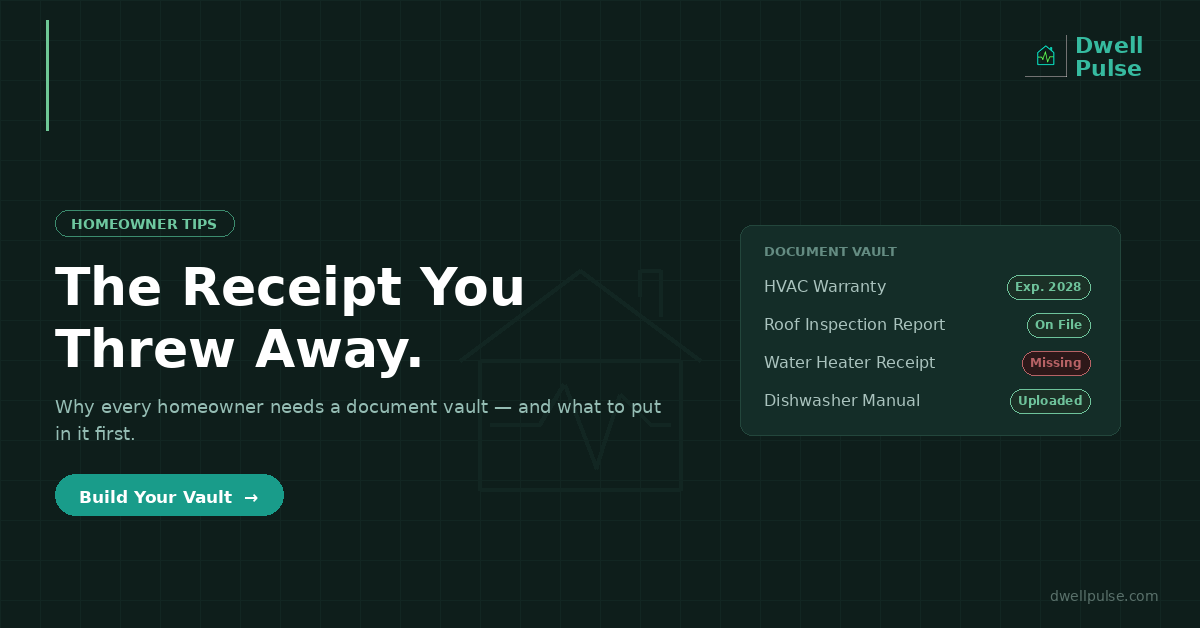
DwellPulse keeps every document attached to the asset it belongs to. When you add a refrigerator to your home, its receipt, warranty, manual, and service history all live with that refrigerator — not in a generic cloud folder you have to dig through. Store warranty expiration dates and get reminders before coverage lapses. Upload paint color codes, HVAC tune-up reports, and roof inspection PDFs so they’re available in the moment you need them. The goal isn’t to become a home archivist — it’s to make sure the next time a warranty claim depends on a receipt, the receipt is already in your pocket.
Build your home’s document vault →
Sources: [1] AAA Appliance Service Center, “Why Do We Need Your Proof of Purchase and Model Tag?” June 2025. [2] Lake Appliance Repair, “4 Things You Don’t Know About the Manufacturer Warranty,” June 2025. [3] This Old House, “Why Was My Home Warranty Claim Denied?” February 2024 survey of 1,000 home warranty customers, updated November 2025.
*Writing assisted by AI
Ready to take control of your home?
DwellPulse is free to start — track maintenance, projects, appliances, and your garden all in one place.
Start Free Today →