The Shut-Off Valve You've Never Tested: A Home Emergency Readiness Guide
It’s 11:47 p.m. on a Tuesday. A supply line under the kitchen sink pops. Water is spraying sideways into the cabinet and pooling onto the hardwood floor. The dog is barking. You have maybe 90 seconds before the damage stops being cosmetic and starts being structural.
Where is your main water shut-off valve? How do you turn it? Which direction do you turn it? Does it even still work, or has it seized after 15 years of sitting untouched?
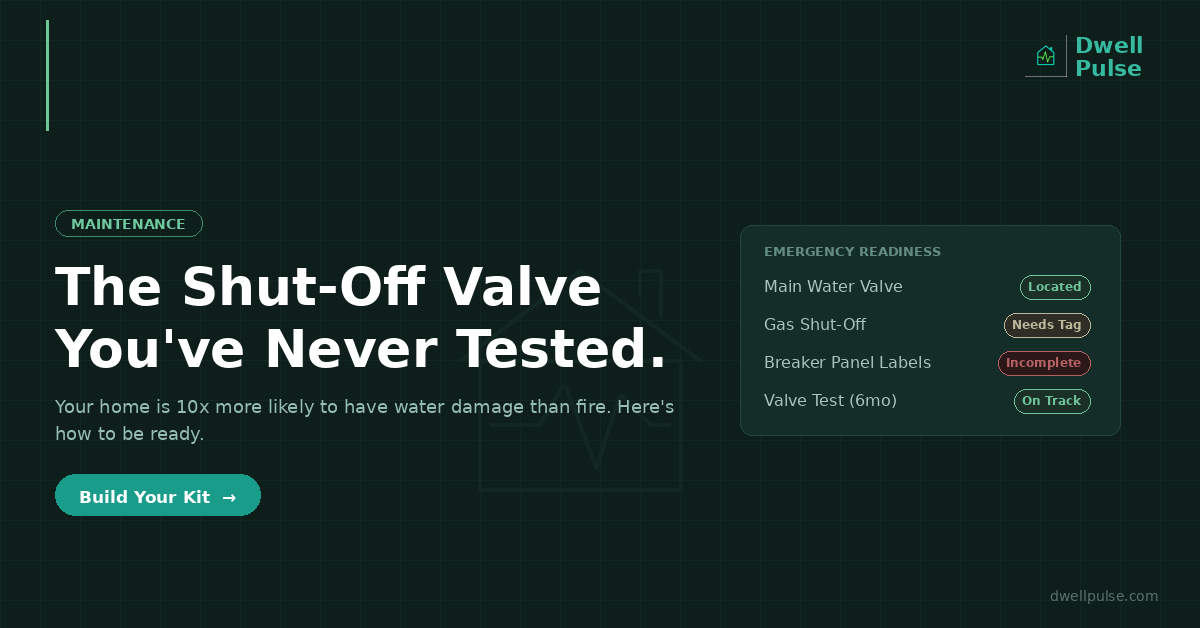
If you hesitated on any of those, you’re in the majority. And it matters more than most homeowners realize: according to Travelers Insurance claims data, homes are 10 times more likely to sustain water damage than fire damage [1]. Yet nearly every household has rehearsed a fire plan, and almost none have practiced a water plan.
The Five Things Every Household Should Know Cold
Emergencies move faster than Google searches. Before anything goes wrong, every adult in the home should be able to locate and operate these five things without pulling out a phone.
- The main water shut-off valve. In homes with basements, it’s usually within a few feet of where the main water line enters the house — often near the front foundation wall [2]. In slab-foundation homes, it’s typically near the water heater, under the kitchen sink, in a utility room, or in a wall panel in the garage. In warm climates, it may be on an exterior wall near an outside faucet. There’s also a curb stop valve at the street, but that one usually requires a water meter key and may only be legally operated by your utility provider.
- The main electrical panel and its main breaker. Not just the location — you need to know which switch is the main shutoff, and whether any circuits are labeled well enough to isolate a problem room without killing power to the whole house. Keep a flashlight near the panel so you can access it in the dark [3].
- The gas shut-off valve. Either at the meter outside (where you’ll need a wrench) or at the appliance level. If you smell gas, you shut it off at the meter, leave the house immediately, and call the gas company from outside — you don’t re-enter to investigate [3].
- The HVAC emergency switch. A red switch usually near the furnace or at the top of basement stairs. If the system is leaking water, smoking, or making a sound it has never made before, this is the kill switch.
- Individual appliance shut-offs. Every toilet has a shut-off valve at the wall. Every sink has two (hot and cold). The washing machine has two. The dishwasher has one under the sink. For most small plumbing emergencies, you can isolate the problem without killing water to the whole house — if you know where to turn.
The Valve Problem Nobody Warns You About
Finding your main shut-off is only half the battle. Gate valves — the ones with a round wheel handle, common in homes built before 2000 — are notorious for seizing up if they haven’t been used in years [4]. In a real emergency, a seized valve can break under force, turning a manageable leak into a catastrophe. Ball valves, with a lever handle that turns a quarter turn, are much more reliable but still need occasional exercise.
Test your valves twice a year. Turn each one fully off and fully on. If a gate valve moves stiffly, leaks around the stem, or won’t fully close, replace it before you need it. A plumber can swap an aging gate valve for a ball valve in under an hour, and you will never regret having spent that money.
Know which tool each valve needs. Some valves require a water meter key. Gas meters usually need a 12-inch adjustable wrench. Keep both within arm’s reach of the valves — not in a toolbox in the garage.
Label every valve. A piece of bright tape or a small hanging tag with “MAIN WATER — TURN CLOCKWISE TO CLOSE” on the valve itself means anyone in the house can act fast: a spouse, a babysitter, a house-sitter, a teenager home alone.
The Information Kit That Pays for Itself
When something goes wrong at 2 a.m. — a burst pipe, a carbon monoxide alarm, a flooded basement — you don’t want to be hunting for your insurance policy number in a filing cabinet. Assemble this once and you’re set for years.
Emergency contacts and account numbers. Your homeowners insurance policy number and your agent’s 24-hour claims line, water/gas/electric utility account numbers and emergency lines, and contact information for a trusted plumber, electrician, and HVAC technician — not the first Google result at 2 a.m., but someone you’ve already vetted.
Proof of what’s in the house. A set of wide-angle photos of every room, showing contents, is the single most valuable piece of documentation you can have after a fire or flood. Insurance adjusters will ask what was in the home, and most people dramatically underestimate their possessions when rebuilding the list from memory [5]. Photos or scans of major receipts — HVAC system, appliances, major electronics, anything over $500 — also belong in this kit.
Serial numbers and model numbers for all major appliances and equipment. When you call a manufacturer or file a warranty claim, these are the first two things they ask for.
The Seasonal Prep That Actually Prevents Damage
Most seasonal checklists are overstuffed with 30 items that feel overwhelming. The items that genuinely prevent catastrophic damage are a shorter list.
- Before the first hard freeze: disconnect exterior garden hoses and turn off the interior shut-off valve for the exterior spigot. Insulate any exposed pipes in unheated spaces (garage, crawl space, attic). Water damage and freezing claims peak in January and February — burst pipes from freezing are the single most common winter water claim [6].
- Before leaving for any trip longer than three days: turn the water heater to vacation mode or shut it off, turn off the main water supply and drain the lines by opening a faucet on the lowest level, and ask a neighbor to check on the house. If you’re leaving in winter, never set the thermostat below 55°F.
- Once a year: test every smoke and carbon monoxide detector and replace batteries, test the main water shut-off valve, test the GFCI outlets in kitchens and bathrooms, and update the photo inventory of every room. This takes a Saturday morning once and then fifteen minutes each year after that.
Why Documentation Changes Everything
Here’s the detail most homeowners don’t think about until it’s too late: insurance companies routinely deny water damage claims they classify as “gradual” rather than “sudden and accidental.” According to industry data, roughly 1 in 10 water damage claims is denied outright, often because the damage was tied to maintenance issues or happened over time rather than suddenly [7]. If an adjuster can argue the damage resulted from deferred maintenance — a water heater you never serviced, hoses you never inspected — your claim may be reduced or denied entirely.
The homeowner who can produce a service record, a photo of the valve in good condition, or a receipt showing the hoses were replaced two years ago is in a fundamentally different position than the one who can’t.
How DwellPulse Helps
DwellPulse gives homeowners a single place to document the information that matters in an emergency — shut-off valve locations, utility account numbers, contractor contacts, insurance policy details, and photos of every room and major system. Store your electrical panel diagram with labeled circuits so anyone can isolate a problem fast. Set recurring reminders for valve tests, detector checks, and seasonal prep so nothing gets forgotten until the moment you need it. Upload service invoices and inspection reports to the Documents vault so your maintenance history is provable when a claim depends on it. The best time to build this kit is a quiet Saturday morning — not the first cold night the pipes freeze.
[
Build your home emergency kit →](https://app.dwellpulse.com)
Sources: [1] Travelers Insurance claims data via Insurance Journal, “Travelers Finds Water Damage Ten Times More Likely Than Fire,” citing the Institute for Business & Home Safety. [2] SERVPRO, “Main Water Shutoff Valve: Where It Is and How to Find It,” November 2025. [3] Nielsen-McAnany Insurance / MHT Insurance, “What Every Homeowner Should Know About Their Utility Shutoffs,” October 2025. [4] Legacy Plumbing, “Shutting Off the Water Valve: Important Plumbing Tips,” March 2025. [5] Lorenz PHAC, “Main Water Shut Off Valve: Location & Safety Tips,” March 2026. [6] This Old House, “Water Damage Statistics,” citing Insurance Information Institute 2025 report based on 2023 data. [7] HealthsureHub, “Top Homeowners Insurance Claims Statistics,” January 2026, noting nearly 1 in 10 water damage claims are denied.
*Writing Assisted by AI
Ready to take control of your home?
DwellPulse is free to start — track maintenance, projects, appliances, and your garden all in one place.
Start Free Today →