What to Ask Your Home Inspector — And What to Actually Do With the Report
You’re about to spend $350 to $600 on a home inspection. The inspector will spend two to four hours reviewing over items in the house, then hand you a 30 to 50 page report full of photographs, descriptions, and recommendations. You’ll flip through it, feel overwhelmed, negotiate a couple of things with the seller, close on the house, and never open the report again.
That last part is the mistake.
According to Porch survey data, 86% of home inspections identify at least one issue requiring attention [1]. The average inspection findings lead to roughly $4,000 in potential repairs, and buyers who use those findings to negotiate walk away with an average of $14,000 off the sale price [2]. But the report’s value doesn’t end at the closing table. It’s the most detailed baseline assessment of your home’s condition you’ll ever receive — and most homeowners treat it like a receipt they’ll never need again.
What an Inspector Actually Checks
Home inspections follow a structured process. The inspector reviews every major system and component in the house, typically organized into these categories:
- Roofing — shingles, flashing, gutters, downspouts, chimneys, skylights, and any visible signs of leaking or deterioration. Roof issues appear in roughly 35% of inspections and are often the most expensive finding [3].
- Electrical — the service panel, circuit breakers, wiring type (copper vs. aluminum), GFCI protection in kitchens and bathrooms, outlet grounding, and smoke/CO detector placement. Minor electrical problems show up in 60–70% of inspections, making them the single most common category of finding [4].
- Plumbing — supply lines, drain lines, water heater age and condition, water pressure, visible leaks, and pipe material (copper, PEX, galvanized, or polybutylene). Roughly 30% of U.S. homes have some form of plumbing leak, and more than 13% of inspections flag plumbing issues specifically [3].
- HVAC — the furnace or heat pump, air conditioning, ductwork, filter condition, thermostat operation, and the age of the system. An HVAC system may be running at the time of inspection but still show signs of aging or deferred maintenance — dirty filters, outdated equipment, or components nearing the end of their service life [5].
- Foundation and structure — visible cracks, settling, water intrusion, floor levelness, and structural support. About 15% of inspections identify foundation or structural issues, and approximately 10% reveal major structural damage [3].
- Insulation and ventilation — attic insulation depth and type, vapor barriers, soffit vents, and bathroom/kitchen exhaust fans. Nearly 40% of homes have faulty or inadequate insulation [3].
- Windows and doors — operation, seals, weatherstripping, and any visible moisture between panes. Window defects appear in about 18% of inspections [2].
What to Ask Before and During the Inspection
Most buyers show up, follow the inspector around silently, and leave. You’ll get far more value if you treat the inspection as a two-hour education in your home.
Before the inspection: Ask the inspector about their experience with your home’s age and construction type. An inspector who’s examined hundreds of 1970s split-levels will notice things a generalist might miss. Ask whether they carry errors-and-omissions insurance. Ask what’s included and what’s not — most standard inspections do not cover sewer scope, radon testing, mold testing, or termite/pest inspections, and these may need to be scheduled separately.
During the inspection: Follow the inspector and ask questions as they go. When they flag something, ask: “Is this a safety issue, a maintenance issue, or a monitoring issue?” That framing helps you prioritize later. Ask them to show you where the main water shut-off is, where the electrical panel is, and where the HVAC filter goes — these are things you’ll need to know as an owner regardless of what the report says.
About the report itself: Ask how findings are categorized. Professional reports typically use a tiered system: safety hazards (immediate attention), necessary repairs (should be addressed), and maintenance recommendations (routine upkeep). Understanding the tier system prevents the common mistake of treating every finding as equally urgent.
How to Read the Report Without Panicking
A 40-page inspection report with 25 flagged items feels alarming. It shouldn’t. Nearly every home — including brand new construction — has findings. A lengthy report is rarely a sign of a bad house. It’s a sign of a thorough inspector.
Focus on the top five categories that matter most: roof, electrical, plumbing, HVAC, and foundation/structure. These are the systems where defects are expensive, where deferred maintenance compounds, and where safety is at stake. Everything else — cosmetic issues, minor code updates, wear items — is maintenance, not crisis.
Separate “fix now” from “fix eventually.” A cracked heat exchanger in the furnace is a safety hazard that needs immediate attention. A missing GFCI outlet in the bathroom is a code update that’s inexpensive and can wait until you’re settled. An aging but functional water heater is a “budget for replacement in 2–3 years” item.
Get contractor quotes for the big items. If the report flags the roof, the HVAC, or the electrical panel, get a licensed contractor to assess and quote the repair before you negotiate with the seller. An inspector identifies the issue; a specialist tells you what it costs to fix. Buyers who negotiate with actual quotes get better outcomes than those who negotiate with vague concerns.
Using the Report to Negotiate
Inspection findings are one of the most powerful negotiation tools in a real estate transaction. Porch data shows that 46% of buyers used inspection results to negotiate a reduced asking price [1]. The average negotiated credit is roughly $14,000 — and that’s across all transactions, including ones where the findings were minor [2].
Focus on safety hazards and major system defects. Sellers are far more likely to agree to credits or repairs for a failing roof, outdated electrical panel, or cracked foundation than for cosmetic issues. Asking for a credit for chipped paint or a squeaky door weakens your negotiating position.
Request credits, not repairs. A seller-ordered repair is done by the seller’s contractor, on the seller’s timeline, to the seller’s standard. A credit lets you hire your own contractor and control the quality. Most experienced agents recommend credits over repairs for exactly this reason.
Use the three-tier framework. Present your requests organized by severity: safety issues first, then active damage, then system lifespan concerns. This approach signals to the seller that you’re being reasonable and data-driven, not nitpicking.
What to Do With the Report After Closing
This is where most homeowners lose the thread — and where the real long-term value lives.
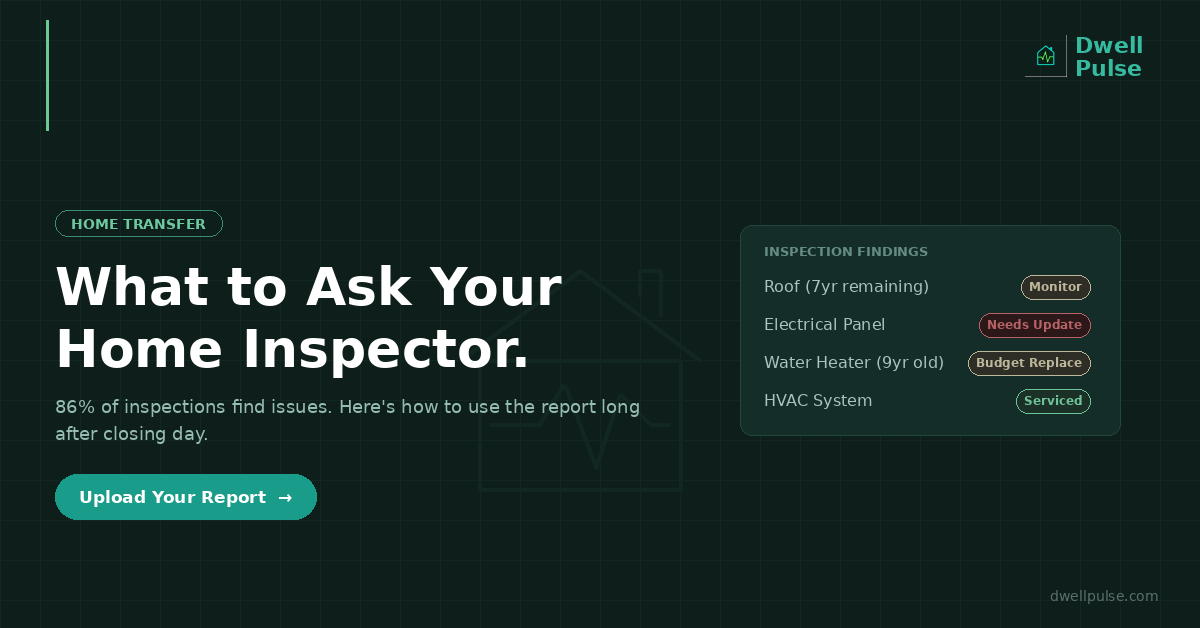
The report is your maintenance roadmap for the next 5–10 years. Every “monitor this” and “replace within X years” finding is a future maintenance task. The inspector told you the water heater was 9 years old, the roof had 5–7 years of remaining life, and the HVAC filter was undersized. Those are three items that need to go on a calendar — not into a drawer.
Store the report digitally and link it to your property. A paper copy in a filing cabinet is worthless when you’re standing in the basement wondering whether the inspector said anything about the sump pump. A searchable digital copy, accessible from your phone, is useful for years.
Use the findings to build your first maintenance schedule. Every flagged item with a lifespan estimate becomes a recurring reminder. Every “have a specialist evaluate” recommendation becomes a task. The inspection report, converted into a living maintenance plan, can prevent thousands of dollars in deferred maintenance costs over the life of your ownership.
Keep it for resale. When you eventually sell, the inspection report from your purchase — plus records of everything you’ve done since — gives your buyer confidence and gives you negotiating leverage. A seller who can show “here’s what was flagged, and here’s every repair and improvement we made” is in a fundamentally stronger position than one who can’t.
How DwellPulse Helps
DwellPulse turns your inspection report from a one-time document into the foundation of your entire home management system. Upload the full report to the Documents vault, linked to your property. Then use the findings to populate your asset records — add the water heater with its age and condition, the HVAC system with its model and service history, the roof with its estimated remaining life. Set recurring reminders for every “monitor” and “replace within X years” item so nothing falls through the cracks.
When the inspector flagged the electrical panel, the plumbing, or the roof, those become tracked assets with service histories that grow over time. Every repair you make, every contractor invoice you upload, and every maintenance task you complete builds on the baseline the inspector established on day one. When it’s time to sell, your complete property history is ready — inspection report, improvements, maintenance records, and documents — all in one place.
[
Turn your inspection report into a plan →](https://app.dwellpulse.com)
Sources: [1] Porch.com survey via LLCBuddy, “Home Inspection Statistics 2025,” 86% of inspections identify at least one issue, 46% of buyers used findings to negotiate price. [2] AmerSave, “The Ultimate Home Inspection Checklist for 2026,” citing average $4,000 in potential repairs, $14,000 average negotiated credit, and defect frequency by category. [3] ZipDo, “Home Inspection Statistics 2025,” citing defect rates: 35% roof, 30% plumbing leak, 40% insulation, 15% foundation, 18% windows. [4] CalPro Group, “What’s the Biggest Red Flag in a Home Inspection,” September 2025, citing 60–70% of inspections find minor electrical problems. [5] AHIT, “2026 Housing Market Predictions Every Home Inspector Should Know,” February 2026.
*Writing assisted by AI
Ready to take control of your home?
DwellPulse is free to start — track maintenance, projects, appliances, and your garden all in one place.
Start Free Today →