When Does a Roof Need Replacing? 8 Warning Signs and Lifespan by Material (2026)
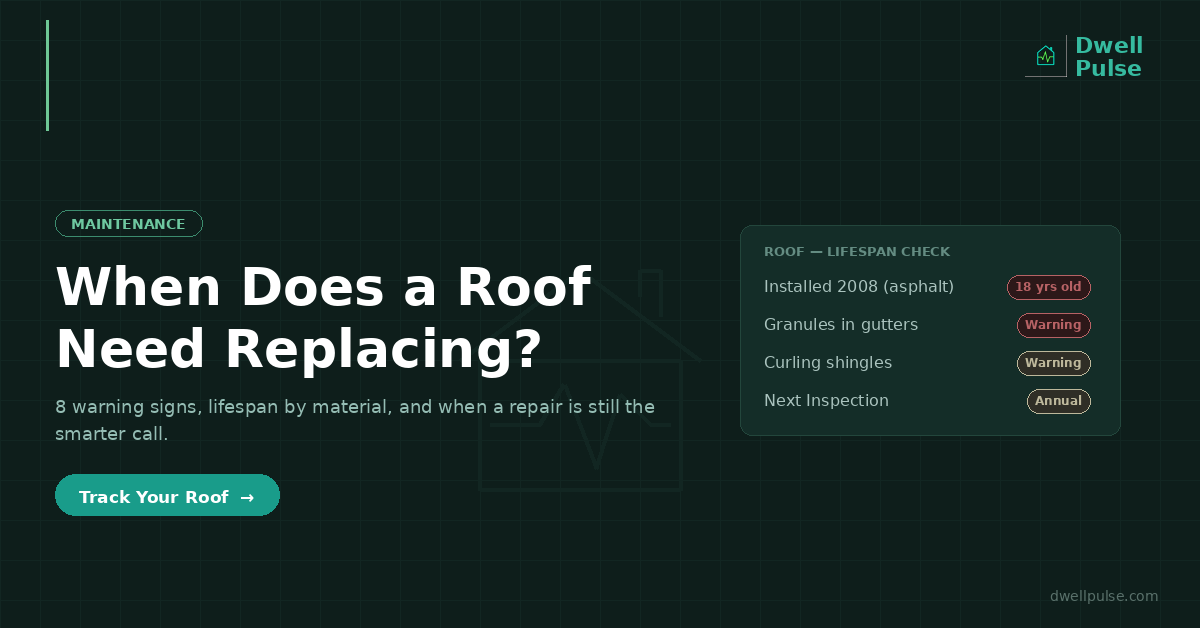
The short answer: most asphalt shingle roofs need replacing every 20 to 30 years — and as early as 15 to 20 for basic three-tab shingles or in harsh climates. But age is only one factor. The clearest way to know is to combine your roof’s age with a check for eight specific warning signs. If your roof is past 15 years old and showing two or more of these signs, it’s time to get a professional inspection and start planning.
This guide covers exactly when a roof needs replacing, how long each roofing material lasts, the warning signs to watch for, and when a repair is still the smarter financial call.
How Long Does a Roof Last? Lifespan by Material
Your roofing material is the single biggest factor in how often you’ll need to replace it [1]:
- 3-tab asphalt shingles: 15–20 years
- Architectural (dimensional) asphalt shingles: 25–30 years
- Wood shakes/shingles: 20–25 years
- Metal roofing: 40–70 years
- Clay or concrete tile: 50+ years
- Slate: 75–100+ years
Asphalt shingles cover roughly 80% of American homes, which is why the 20–30 year figure is the one most homeowners need [2]. But the same shingle can last very different amounts of time depending on three things: climate (hail, high winds, and freeze-thaw cycles all shorten lifespan), installation quality (poor nailing or flashing causes premature failure), and attic ventilation (the number-one cause of early roof failure — trapped heat literally cooks shingles from below) [3].
The 8 Warning Signs Your Roof Needs Replacing
Walk your yard first, then check your attic with a flashlight. Look for these signs before the next storm:
1. Age past 20 years. If your asphalt roof is over 20 years old, start planning for replacement even if it looks okay from the ground. Age is the most reliable single predictor [4].
2. Curling or buckling shingles. Shingles curling at the edges or buckling in the middle have dried out and reached the end of their life. They can no longer shed water effectively, which means leaks are coming [5].
3. Missing, cracked, or broken shingles. Gaps in coverage let water reach the underlayment and decking. A few missing shingles can be repaired; widespread loss signals replacement [5].
4. Granules in the gutters. Those sand-like granules protect the asphalt from UV rays. When you find piles of them in your gutters or at the base of downspouts, and bald spots on the shingles, the roof is wearing out fast [6].
5. Water stains on ceilings or in the attic. Interior water stains, musty odors upstairs, or visible mold mean the roof’s barrier has already failed. This is a sign to act immediately, not monitor [7].
6. Daylight through the roof boards. In the attic, if you can see daylight coming through the roof deck, water can get in too. Sagging areas indicate the decking is rotting from moisture [8].
7. Moss, algae, or dark streaks. Moss and algae trap moisture against the shingles and accelerate deterioration, especially on the shady side of the roof. Dark streaks signal algae; thick green growth signals moss that’s holding water against the deck [6].
8. Frequent repairs. If you’re calling a roofer for the same or different problems repeatedly, the roof is telling you it’s reaching system-wide failure rather than isolated damage. At that point, replacement is usually more cost-effective than continued patching [1].
Repair or Replace? The 25% Rule
Not every problem means a full replacement. Roofing professionals generally apply the 25% rule: if more than 25% of the roof is damaged, or the roof is near the end of its expected lifespan, replacement is almost always the more cost-effective choice [9]. If the damage is localized — a few shingles blown off in one storm on an otherwise young, healthy roof — a repair makes sense.
Two practical guidelines:
- Young roof, isolated damage → repair. A 7-year-old roof that lost shingles in a windstorm is a patch job.
- Old roof, widespread damage or repeated repairs → replace. A 22-year-old roof with curling shingles across multiple slopes is past the point of throwing money at repairs.
What Does a New Roof Cost in 2026?
A new roof typically runs $5,000 to $15,000 for an average home, depending on size, pitch, and material — with larger homes and premium materials reaching $20,000 or more [10]. Asphalt shingles are the most affordable; metal, tile, and slate cost more upfront but last far longer, often providing better value over the decades you own the home.
There’s also an insurance angle worth knowing: many insurers reduce your homeowners premium after a fresh roof, especially with impact-resistant Class 4 shingles in storm-prone regions — and an aging roof can quietly trigger a non-renewal notice at your next policy review [11].
Why You Should Know Your Roof’s Exact Age
Every guideline above hinges on one fact most homeowners can’t answer with confidence: how old is the roof, exactly? “Sometime after we moved in” isn’t good enough to apply the 20-year rule, and if you bought the home with the roof already on it, you may have no idea when it was installed.
Knowing your roof’s install date changes everything. It tells you which inspection schedule to follow (every 2–3 years from age 12–15, annually after 20), when to start budgeting for replacement, and whether a problem is “repair the young roof” or “replace the old one.” It’s also the documentation a buyer’s agent and home inspector will ask for when you sell — a roof with a known install date and a workmanship warranty on file is worth more than one that’s a question mark.
Frequently Asked Questions
How often should you replace your roof? Most asphalt shingle roofs need replacing every 20–30 years (15–20 for basic 3-tab shingles). Metal roofs last 40–70 years, and tile or slate can last 50–100+ years [1][2].
What are the signs you need a new roof? The most common signs are curling or missing shingles, granules collecting in gutters, water stains on ceilings, moss or algae growth, daylight visible through the attic, and a roof age over 20 years [4][6].
Can I just repair my roof instead of replacing it? Yes, if the damage is localized and the roof is otherwise young and healthy. But if more than 25% of the roof is damaged or it’s near the end of its lifespan, replacement is usually more cost-effective [9].
How much does a new roof cost in 2026? A typical roof replacement runs $5,000–$15,000, with larger homes and premium materials reaching $20,000 or more [10].
How often should I get my roof inspected? Once a year is plenty for most homes, plus an extra check after any hail, high wind, or major storm. From age 12–15, inspect every 2–3 years; after 20, inspect annually [3][12].
How DwellPulse Helps
DwellPulse takes the guesswork out of the single fact every roofing decision depends on: your roof’s age. Log your roof with its install date, material, and warranty details, and DwellPulse tracks where it sits in its expected lifespan and reminds you to inspect it on the right schedule — every few years early on, annually as it ages. Store the original invoice, the workmanship warranty, and inspection reports so the documentation is ready when you need to file a claim or sell the home. And because DwellPulse forecasts your big-ticket replacement costs years ahead, you’ll see the roof replacement coming in time to budget for it — instead of discovering it the day a stain appears on the ceiling.
Track your roof’s age and lifespan →
Sources: [1] DLV Roofing, “How Often Should You Replace Your Roof? Lifespan Guide,” November 2026, and Premier Roofing, “Asphalt Shingles Lifespan,” March 2026, on lifespan by material and the repeated-repairs signal. [2] Peak & Valley Roofing, “10 Clear Signs It’s Time for a New Roof in 2026,” March 2026, noting asphalt covers ~80% of U.S. homes and the 20–30 year range. [3] DLV Roofing, citing poor attic ventilation as the top cause of premature roof failure and recommended inspection cadence. [4] Boelter, “When to Replace Your Asphalt Shingle Roof,” February 2025, on age over 20 years as the clearest indicator. [5] United Better Homes, “When Do Roofs Need to Be Replaced? 8 Warning Signs,” March 2026, on curling, missing, and broken shingles. [6] Bill Ragan Roofing, “6 Signs You Need to Replace Your Asphalt Roof,” on granule loss and moss/algae growth. [7] Peak & Valley Roofing, on interior water damage and mold signaling barrier failure. [8] Teachout Builders, “Roof Shingle Replacement Signs,” April 2026, on daylight through decking and sagging. [9] Teachout Builders, on the 25% rule for repair vs. replacement. [10] Today’s Homeowner, “When Should You Replace Your Roof? (2026),” on the $5,000–$15,000 average cost range. [11] DLV Roofing, on insurance premium reductions for new and Class 4 roofs and non-renewal risk for aging roofs. [12] Premier Roofing, on the age-based inspection timeline (every 2–3 years from 12–15, annually after 20).
* This article was written with the assistance of AI tools. All content is reviewed and edited by Josh Standeven.
Ready to take control of your home?
DwellPulse is free to start — track maintenance, projects, appliances, and your garden all in one place.
Start Free Today →