Why a Connected Home System Beats a Pile of Reminders (and What It Unlocks)
Most homeowners manage their house with a scattered collection of tools: a reminder app for the furnace filter, a folder of PDFs for warranties, a shoebox of receipts, a note somewhere with the roof’s install year, a spreadsheet for the renovation budget. Each one does its small job. None of them talk to each other.
That disconnection is the hidden reason home management feels like a chore that never quite gets done. A reminder that isn’t attached to anything is just a nag. A receipt in a folder is just paper. The roof’s install date, sitting in a note by itself, is trivia. Individually, these fragments have almost no power. Connected, they become something genuinely useful: a system that doesn’t just store information, but tells you things you didn’t know.
The Problem with Managing a Home in Fragments
When your home’s information lives in separate silos, every question requires reassembling it by hand.
Is the dishwasher still under warranty? You’d need to find the purchase date (a receipt somewhere), the warranty length (a manual somewhere), and do the math. Should I repair or replace the water heater? You’d need its age (a guess), its expected lifespan (a search), and a repair quote. What did I spend on the house last year? You’d need to gather receipts from email, credit card statements, and the contractor’s invoices scattered across three folders.
Each of these is answerable, but only through tedious reconstruction — which is exactly why most homeowners don’t bother, and end up making decisions on guesses instead. The information existed. It just wasn’t connected.
What “Connected” Actually Means
A connected home management system links every piece of information to the thing it describes, so context travels with the data.
The water heater isn’t just a reminder to flush it — it’s a record with an install date, a warranty expiration, a service history, an expected lifespan, and the original receipt, all attached to the same object. When you open it, everything you need is right there. The renovation project isn’t just a budget number — it’s a record holding the contractor’s invoice, the permit, the before-and-after photos, the materials list, and the total cost, all in one place.
Because everything is connected, the system can answer questions no single fragment could. It knows the dishwasher is 4 years old and that its warranty runs 5 years, so it can tell you the claim is still valid. It knows the roof went on in 2016 and that asphalt shingles last around 20 years, so it knows roughly when you’ll be replacing it. It knows what you paid for the last three projects, so it can total your investment in the home without you gathering a single receipt.
This is the difference between a filing cabinet and an assistant. A filing cabinet holds what you put in it. A connected system uses what you put in it.
The Compounding Value of One Source of Truth
There’s a second, quieter benefit to connection: the value grows over time.
Every appliance you add, every project you log, every maintenance task you complete becomes part of a single, growing record of your home. Year one, it’s a modest inventory. Year three, it’s a documented history — which appliances have needed repairs, which contractors did good work, what you’ve spent, what’s aging. Year five, when you’re deciding whether to sell or renovate, or when a buyer’s agent asks for your maintenance records, that connected history is a genuine asset instead of a scramble.
Disconnected tools can’t compound like this. A reminder app forgets everything the moment a task is done. A folder of PDFs doesn’t get smarter. Only a connected system turns years of small entries into something more valuable than the sum of its parts.
Where It All Pays Off: Seeing Your Costs Before They Arrive
Here’s where the connection produces something you genuinely cannot get any other way.
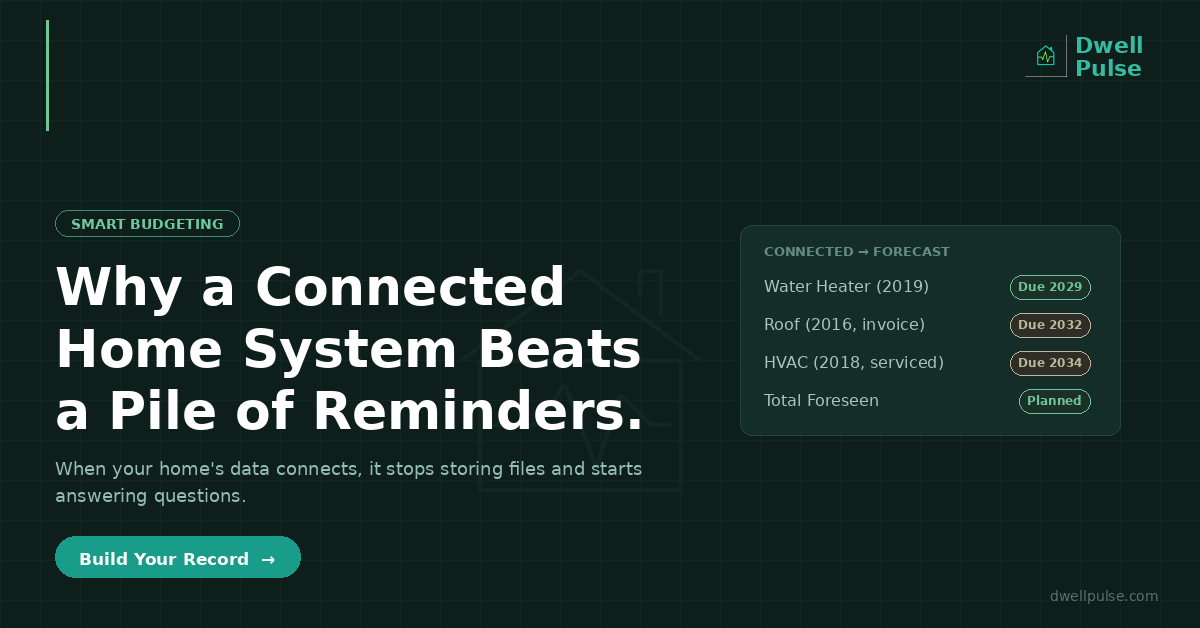
Once your home’s systems and appliances are logged — each with an age, an expected lifespan, and a replacement cost — the system has everything it needs to look forward. It can calculate when each item will reach the end of its life and lay out the replacement costs year by year: the water heater in 2029, the roof in 2032, the HVAC in 2034. It can adjust those future costs for inflation, so you’re seeing realistic numbers, not today’s prices frozen in time.
This is DwellPulse’s Expense Forecast, and it’s the clearest example of why connection matters. No single reminder could produce it. No folder of receipts could produce it. It only becomes possible when the ages, lifespans, and costs of everything in your home live in one connected system that can do the arithmetic across all of it at once.
The payoff is the difference between being blindsided and being prepared. Instead of a water heater failure becoming a surprise $1,800 credit-card charge, you saw it coming three years out and saved for it. Instead of two major systems both failing in the same year and wrecking your budget, you knew the double-hit was coming and planned around it. A connected system doesn’t just record your home’s past — it shows you its future.
How DwellPulse Helps
DwellPulse is built as one connected system rather than a pile of separate tools. Your appliances, systems, projects, documents, maintenance history, and even your garden all live together, each piece linked to the things it relates to — so the app can answer questions instead of just storing files. Warranty status, repair-or-replace decisions, total investment in your home, and what’s coming next all become things you can simply look up.
The forward-looking payoff, Expense Forecast, is a DwellPulse Pro feature — and Pro includes a free trial, so you can connect your home’s data, generate your first multi-year forecast, and see exactly what your house will cost you before deciding whether to subscribe. Start by logging your major systems and appliances; the more connected your home’s data becomes, the more the system can tell you that you didn’t already know.
Start building your connected home record →
Expense Forecast is a DwellPulse Pro feature. Pro is available with a free trial; features, trial terms, and pricing are described as of publication and may change — see the app for current details.
* This article was written with the assistance of AI tools. All content is reviewed and edited by Josh Standeven.
Ready to take control of your home?
DwellPulse is free to start — track maintenance, projects, appliances, and your garden all in one place.
Start Free Today →