Why Your Contractor Receipts Matter More Than You Think
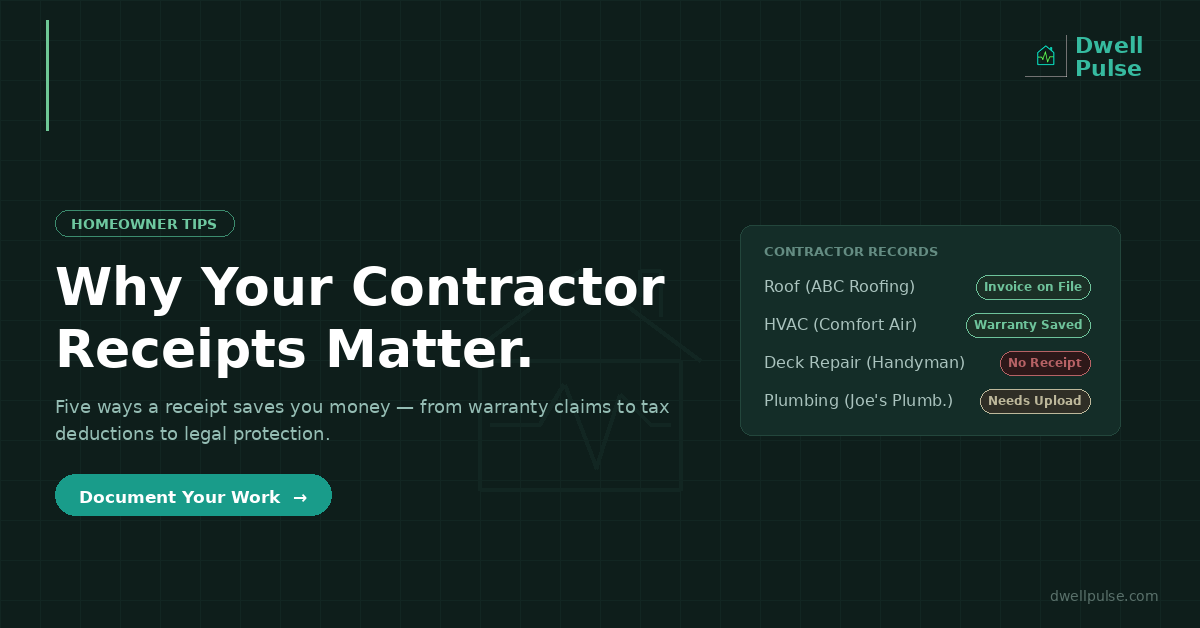
The roofer finishes the job. You write a check, shake hands, and forget about the roof for the next 15 years. The HVAC company replaces your system. They email a receipt that gets buried under 4,000 other emails within a week. The handyman fixes the deck railing on a Saturday morning. You pay him via Venmo and never think about it again.
Every one of those transactions generated a piece of paper — or should have — that you’ll desperately want years from now when a warranty claim is denied, an insurance adjuster asks for proof of maintenance, a tax advisor needs your cost basis, or a buyer’s agent wants to see what work has been done on the house.
The home improvement industry ranks among the top categories for consumer complaints at both the Better Business Bureau and the Federal Trade Commission, with reports of contractor disputes, unfinished work, and documentation gaps continuing to rise through 2024 and 2025 [1]. The contractors involved in most of these disputes aren’t scammers — they’re legitimate tradespeople whose work was never properly documented by the homeowner. When the relationship is good, nobody thinks about the paperwork. When something goes wrong, the paperwork is everything.
Five Ways a Receipt Saves You Money
Most homeowners think of a contractor receipt as proof they paid for something. It is. But that’s the least important thing it does. A contractor receipt — properly stored and linked to the work it represents — protects you in at least five distinct ways.
-
Warranty claims. Most HVAC systems, roofing materials, and major home installations carry manufacturer warranties that require proof of professional installation. A $9,000 HVAC system may have a 10-year parts warranty — but only if you can prove it was installed by a licensed contractor. The receipt and the installation invoice are your proof. Without them, the manufacturer can deny the claim and point you to the fine print [2].
Many contractors also provide a workmanship warranty separate from the manufacturer warranty. If the flashing on your roof starts leaking three years after installation, the roofing contractor’s workmanship warranty covers the labor to fix it — but only if you can prove who did the original work, when, and under what terms. A receipt with the contractor’s license number, scope of work, and date is the minimum documentation you need.
-
Insurance claims. When you file a homeowners insurance claim, the adjuster will ask what improvements have been made to the property and when. Receipts and invoices serve as “proof of loss” — documented evidence that the damaged item existed, what it cost, and what condition it was in [3]. Without sufficient documentation, including receipts and estimated values, claims can be denied outright [4]. This is particularly important after catastrophic events — fires, floods, storms — where the physical evidence may be destroyed along with the receipt drawer. A digital copy stored outside the home survives when the kitchen drawer doesn’t.
-
Tax cost basis. As covered in our earlier post on tracking home improvements for resale, every capital improvement adds to your home’s cost basis, reducing your taxable gain when you sell. The IRS requires dated receipts and invoices showing the contractor, scope of work, and total cost [5]. A $18,500 roof replacement that you can prove reduces your capital gains tax by $2,775 to $4,400 depending on your rate. A roof replacement you can’t prove reduces your tax bill by zero.
-
Resale value and buyer confidence. Buyers and their agents increasingly ask for maintenance and improvement records. A seller who can produce a documented history of professional work — licensed contractors, dated invoices, permits, inspection reports — commands more buyer confidence than one who says “yeah, we had some work done a few years ago.” In a market where homes are inspected, appraised, and scrutinized, documentation is a competitive advantage.
-
Legal protection in disputes. If a contractor does substandard work and you need to pursue a claim, your documentation is your case. Courts and arbitrators look for written contracts, invoices showing the agreed scope and cost, proof of payment, and any written communication about the work [6]. A homeowner who paid in cash with no receipt and no written agreement has almost no legal standing. A homeowner with a signed contract, dated invoice, proof of payment, and photos of the completed work has a case.
What a Proper Contractor Receipt Should Include
Not all receipts are equal. A credit card statement showing a $4,200 charge to “ABC Services” tells you almost nothing useful. A proper contractor receipt or invoice should include:
- Contractor name and business information — legal business name, address, phone number, and license number (if applicable in your state)
- Date of service — when the work was performed
- Detailed scope of work — not just “plumbing repair” but “replaced main water shut-off valve (3/4” brass ball valve), replaced supply line to kitchen sink, and pressure-tested system to 80 PSI"
- Materials used — type, brand, and model numbers where applicable (especially for warranties)
- Total cost — broken out by labor and materials if possible
- Payment method and confirmation — check number, credit card last four digits, or electronic payment reference
- Warranty terms — the contractor’s workmanship warranty duration and what it covers
If the contractor doesn’t provide this level of detail on their standard invoice, ask for it. Most professionals will accommodate the request — it’s in their interest too, since clear documentation prevents disputes from both sides.
The Cash and Venmo Problem
Cash payments and peer-to-peer payment apps (Venmo, Zelle, PayPal) create a documentation gap that trips up homeowners constantly. Today’s Homeowner specifically flags cash-only contractors as a warning sign — not necessarily of fraud, but because cash payments leave homeowners without a paper trail that’s usable in disputes, warranty claims, or tax filings [7].
If you do pay by Venmo or Zelle, the transaction record shows the amount and date but not the scope of work. You need to pair it with a written invoice or receipt from the contractor. The payment confirmation alone is not sufficient documentation for any of the five scenarios above.
Best practice: Always request a written invoice regardless of payment method. Photograph it immediately. Store it digitally, linked to the specific project or asset it relates to. If the contractor provides only a handwritten estimate, photograph that too — it’s better than nothing and establishes the agreed scope and price.
How DwellPulse Helps
DwellPulse connects contractor documentation to the work it represents. Every project has its own document vault where receipts, invoices, contracts, permits, and photos live alongside the project record — not in a generic folder, not in a camera roll, not in an email thread you’ll never find again.
Save contractors to your Contractors list with their license number, specialties, and contact information so you have a verified record of who did the work. Link contractors to specific projects and assets so the relationship is documented: “ABC Roofing installed the roof in March 2024, here’s the invoice, here’s the warranty, here’s their license number.”
Upload receipts the day they arrive — from your phone, on-site, in under a minute. When a warranty claim requires proof of professional installation, when an adjuster asks for documentation, when your accountant needs the cost basis, or when a buyer’s agent wants the improvement history — every receipt is already organized, searchable, and linked to the work it paid for.
Start documenting your contractor work →
Sources: [1] Inszone Insurance, “End-of-Year Home Repairs Are Surging, and So Are Contractor Fraud and Liability Risks,” January 2026, citing FTC, BBB, and state licensing board data on rising contractor dispute reports. [2] ConsumerAffairs, “What to Do When Your Home Warranty Claim Is Denied,” June 2026, noting the requirement for proof of installation, maintenance records, and purchase receipts for warranty appeals. [3] Angi, “Contractors and Insurance Claims: What To Know,” March 2026, noting receipts serve as “proof of loss” and that claims can be denied without them. [4] Insurify, “What to Do If Your Home Insurance Claim Is Denied,” February 2026, citing insufficient documentation as a common reason for claim denials. [5] IRS Publication 523 and 551, via SmartAsset and Jackson Hewitt guides, requiring dated receipts for capital improvement cost basis claims. [6] LegalMatch, “Suing a Contractor: Legal Claims, Steps, and Tips for Homeowners,” February 2025, noting documentation and receipts as key evidence. [7] Today’s Homeowner, “Beware the Telltale Signs of Contractor Scams,” April 2025, flagging cash-only payments as leaving homeowners without a usable paper trail.
*Writing assisted by AI
Ready to take control of your home?
DwellPulse is free to start — track maintenance, projects, appliances, and your garden all in one place.
Start Free Today →