Your Roof Has an Expiration Date — Here's How to Know What It'll Cost You in 2032
The roof you’re standing under has a number of years left in it. So does your furnace, your air conditioner, your water heater, your dishwasher, and every other major system in your home. Each one is quietly counting down toward a replacement date — and on that date, it’s going to hand you a bill.
The problem isn’t that these costs exist. Every homeowner knows the roof won’t last forever. The problem is that the bills arrive as surprises. The water heater fails on a Tuesday and you’re suddenly shopping for a $1,800 replacement you hadn’t planned for. The HVAC system dies in the first August heat wave and the bill is $13,430 — the current average for a combined AC and furnace replacement on a typical home [1]. None of it was unpredictable. All of it was unplanned.
That gap — between predictable and planned — is exactly what DwellPulse’s Expense Forecast was built to close.
Every System Has a Knowable Lifespan
The reason these expenses are forecastable is that home systems fail on remarkably consistent timelines. Decades of warranty data, manufacturer specifications, and home inspection records have established reliable lifespan ranges for nearly everything in a house:
- Tank water heaters: 8–12 years [2]
- Furnaces: 15–20 years [3]
- Central air conditioning: 10–15 years [4]
- Asphalt shingle roofs: 12–20 years [5]
- Heat pumps: 10–15 years [5]
- Dishwashers: 9–12 years
- Galvanized water pipes: 20–25 years [5]
If you know when a system was installed and how long that type of system typically lasts, you can calculate — with surprising accuracy — the year it will need replacing. A water heater installed in 2019 with a 10-year lifespan is going to need replacing around 2029. A roof installed in 2015 with a 17-year lifespan points to 2032. This isn’t fortune-telling. It’s arithmetic. The trouble is that no homeowner does this arithmetic across every system in their house and lays it out on a timeline.
DwellPulse does.
How the Expense Forecast Works
The Expense Forecast is one of DwellPulse’s most distinctive features — a tool that turns your home’s inventory into a year-by-year projection of upcoming replacement costs. Here’s what happens under the hood.
It pulls from your real assets and projects. The forecast looks at every appliance and major system you’ve added to DwellPulse that has three pieces of information: an install date, an expected lifespan, and an estimated replacement cost. It also looks at every completed project — a roof replacement, a deck build, an HVAC install — that has a completion date, a lifespan, and a recorded cost.
It calculates each replacement year. For each item, the forecast adds the expected lifespan to the install or completion date to determine the replacement year. A furnace installed in 2018 with a 16-year lifespan lands on 2034. Every item gets its own replacement year on the timeline.
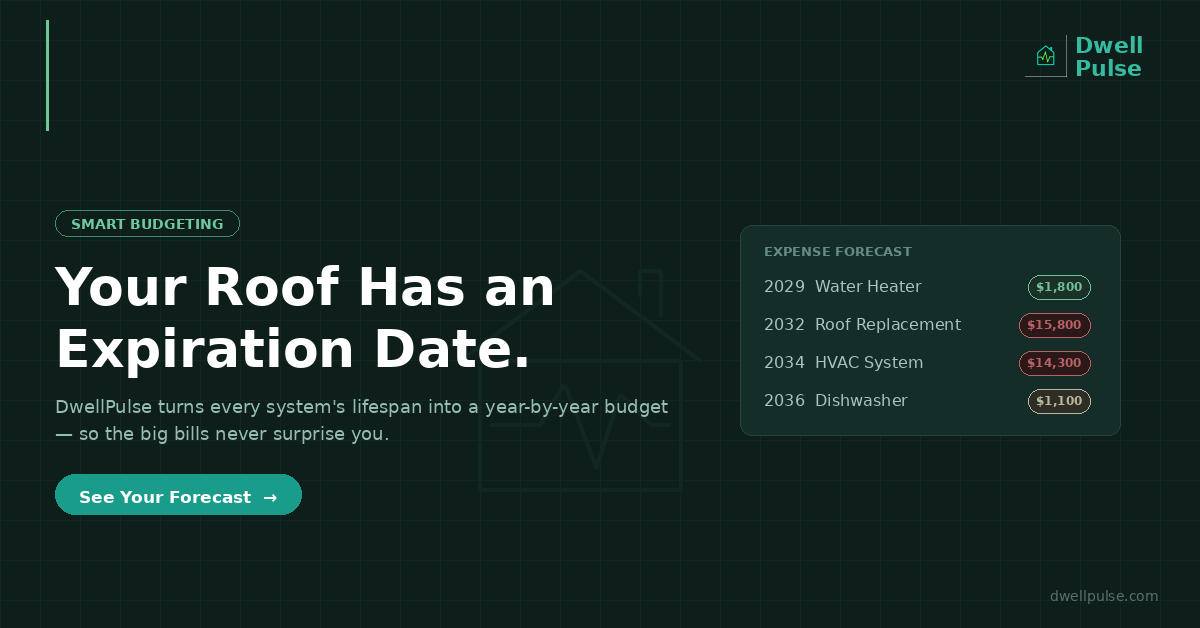
It groups costs by year. Instead of a single overwhelming number, the forecast organizes everything into a year-by-year breakdown. You can see that 2029 brings a $1,800 water heater, 2032 brings a $14,000 roof, and 2034 brings a $13,000 HVAC system — each year’s total clearly displayed, with the individual items sorted by cost so the big-ticket replacements rise to the top.
It accounts for inflation. Optionally, the forecast applies an inflation rate (default 2%) to future costs, so the $14,000 roof you’d pay for today is projected at what it’s likely to actually cost in 2032. A replacement six years out at 2% inflation isn’t $14,000 — it’s closer to $15,800. The forecast shows you the realistic future number, not the today number.
It’s adjustable. Lifespans aren’t one-size-fits-all. If you know your water heater is a premium model rated for 15 years instead of 10, you can adjust its lifespan right in the forecast — and watch the replacement year and the year-by-year totals update instantly. Your forecast reflects your home, not a generic average.
You set the horizon. By default, the forecast projects 30 years out — but you can narrow it to the next 5 or 10 years if you want to focus on the near term, or expand it to see the full long-range picture of what your home will demand over the decades you own it.
Why This Changes How You Budget
A forecast isn’t just informative — it’s the difference between funding a maintenance account and funding a credit card. As we’ve covered before, 58% of homeowners have nothing saved for emergency repairs, and 30% have gone into debt completing home projects [6]. The root cause is almost always the same: the expense was a surprise, so there was no time to save for it.
When you can see that 2032 brings a $15,800 roof replacement, you have six years to set aside $220 a month — and the expense arrives as a planned withdrawal from a savings account instead of an emergency charge at 24% APR. When you can see that two major systems both hit their replacement year in 2034, you can plan to stagger one of them early, or start saving sooner, or budget for the double-hit deliberately.
This is also a powerful tool at the point of purchase. A homeowner considering an offer on a house can build a quick forecast from the inspection report — water heater age, roof age, HVAC age — and see the looming replacement costs before they buy. A house with a 16-year-old roof, an 11-year-old water heater, and a 14-year-old furnace isn’t just a purchase price; it’s a purchase price plus roughly $30,000 in replacements coming within five years. The forecast makes that visible.
The Lifespan Progress Bar
DwellPulse reinforces the forecast at the individual asset level too. When you view any appliance with an install date and expected lifespan, you’ll see a lifespan progress bar showing how much of its expected life has been used — green when it’s in the early years, yellow as it approaches 80% of its life, and red when it’s living on borrowed time.
This turns an abstract date into an at-a-glance health indicator. A water heater showing a red bar at 95% of its lifespan is telling you, every time you look at it, that a replacement is imminent — and that it’s time to start getting quotes rather than waiting for the cold-shower morning that forces an emergency purchase.
How DwellPulse Helps
The Expense Forecast is the payoff for keeping your home inventory current. Add your appliances and major systems with their install dates, expected lifespans, and replacement costs. Record your completed projects with their costs and lifespans. Then let the forecast do the arithmetic across your entire home — every replacement year, every projected cost, inflation-adjusted and grouped by year, across whatever horizon you choose.
The result is something most homeowners have never had: a clear financial picture of what their home will demand of them over the next 5, 10, or 30 years. No more surprises. No more emergency credit card charges. Just a plan you can actually save against — because you can finally see what’s coming.
The Expense Forecast is a Premium feature in DwellPulse.
See your home’s financial future →
Sources: [1] Modernize, “New HVAC System Cost Calculator,” 2026, average HVAC replacement $11,590–$14,100, ~$13,430 for a typical 2,000–2,500 sq ft home, based on 56,000 homeowner projects. [2] Angi, “Water Heater Replacement Cost,” May 2026, tank water heaters last 8–12 years. [3] Choice Home Warranty / Edina Realty, “How Long Does HVAC Last,” August 2025, furnaces last 15–20 years. [4] This Old House, “How Long Your Home’s Components Last,” March 2026, AC compressors and furnaces ~15 years. [5] Blue Ribbon Home Warranty, “Average Repair Costs & Life Expectancy,” lifespan ranges for roofing, heat pumps, plumbing, and HVAC. [6] Clever Offers, “Home Renovation Trends 2026,” February 2026, 58% have nothing saved for emergency repairs, 30% went into debt.
*Writing assisted by AI
Ready to take control of your home?
DwellPulse is free to start — track maintenance, projects, appliances, and your garden all in one place.
Start Free Today →