Solar Panel Maintenance: What Actually Needs Doing (and What Doesn't)
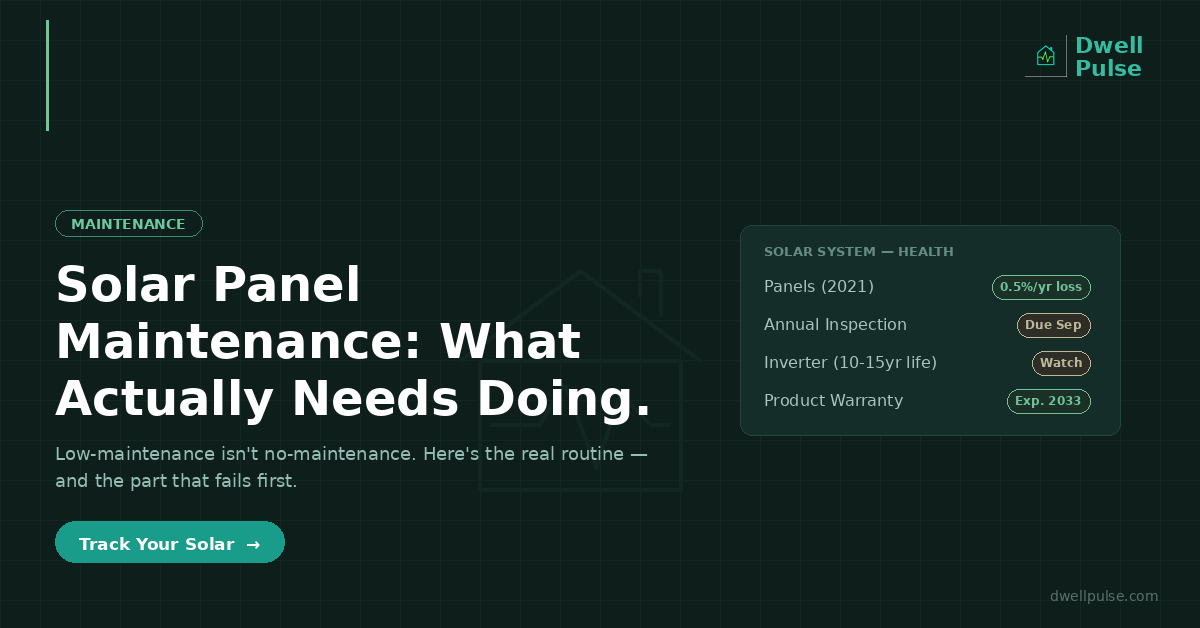
Solar panels have a well-earned reputation for being low-maintenance. With no moving parts and a solid-state design, a rooftop solar array will quietly generate power for decades with far less attention than almost any other major home system. But “low-maintenance” gets misread as “no-maintenance,” and that’s where solar owners get into trouble — a neglected system slowly loses output, and an undocumented one can lose a warranty claim.
Here’s the honest picture of what solar maintenance actually involves: what needs doing, how often, what you can do yourself, and the one component that will almost certainly need replacing before your panels do.
Do Solar Panels Really Need Maintenance?
Yes — but not much. Because photovoltaic panels have no moving parts, they don’t wear out the way a furnace or a washing machine does [1]. What they need is periodic cleaning and inspection to maintain performance, not constant servicing.
The consensus from installers and industry sources is straightforward: bi-annual cleaning (when needed) and an annual inspection keep a system performing at its peak and can extend its life well beyond 20 years [2]. That’s the entire core routine. Everything else is monitoring and the occasional professional visit.
One important caution that surprises people: over-maintenance can actually void warranties. Aggressive cleaning with high-pressure washers, abrasive pads, or harsh chemicals can scratch the glass or damage frame seals [3]. With solar, gentle and occasional beats frequent and forceful.
How Long Do Solar Panels Last?
Modern solar panels are built to last 25 to 30+ years, and they degrade remarkably slowly. The National Renewable Energy Laboratory found panels have a median degradation rate of about 0.5% per year [4]. At that rate, a panel is still producing around 80–90% of its original output after 25 years — which is why most manufacturers offer a performance warranty guaranteeing at least 80% output at year 25 [5].
For realistic long-term planning, many solar experts suggest assuming a slightly more conservative 0.5–0.75% annual degradation rather than the manufacturer’s most optimistic figures [6]. Either way, the panels themselves are the last thing you’ll worry about.
The Part That Actually Needs Replacing: Your Inverter
Here’s the single most important thing for a solar owner to understand: your inverter will almost certainly fail before your panels do.
The inverter — the component that converts the panels’ DC power into the AC power your home uses — is the workhorse of the system, and it has a much shorter lifespan than the panels it serves. Typical string inverter lifespan is 10 to 15 years, against a 25–30 year panel warranty [7]. That mismatch means most systems will need at least one inverter replacement during their life, at a cost commonly cited around $2,500 [6].
A few practical points on inverters:
- Ventilation matters. Inverters installed in hot, enclosed spaces like lofts run hotter and degrade faster. Keep the ventilation slots clear of dust and the location as cool and shaded as practical [3].
- Watch for warning signs. Persistent error codes that don’t clear after a restart, unusual buzzing or rattling, or the system going offline all warrant a professional check.
- Microinverters are different. Systems using microinverters (one small unit per panel) often carry 25-year warranties matching the panels, and a single failure affects only one panel rather than the whole system.
If your inverter is 10+ years old, it’s worth a professional check of its key components — and worth budgeting for its eventual replacement as a known, plannable cost rather than a surprise.
What You Can Safely Do Yourself
Homeowners can handle the light-touch parts of solar maintenance safely from the ground:
- Visual inspections using binoculars — look for cracks, discoloration, loose mounting, or debris buildup on the panels [1].
- Performance monitoring through your system’s smartphone app — this is your early-warning system (more below).
- Gentle cleaning of accessible panels with a soft brush or hose on an extension pole, when rainfall isn’t keeping them clean.
- Checking inverter status lights and keeping the inverter’s surroundings clear.
The hard safety rule: never walk on panels, and never attempt electrical work. Connection inspections, firmware updates, thermal imaging, and any high-voltage troubleshooting must be done by certified professionals — both for your safety and to keep your warranty valid [3]. Anything requiring roof access is also best left to a pro unless you’re properly equipped.
When Does Cleaning Actually Matter?
Dirt, pollen, bird droppings, leaves, and dust reduce how much sunlight your panels absorb. In the U.S., soiling losses average up to about 7% annually, and dirty panels can lose anywhere from 2–5% of production in typical conditions — more in dusty, agricultural, or coastal environments [8].
The good news: in most regions, regular rainfall keeps panels reasonably clean without any manual intervention [9]. Cleaning becomes worth the effort when:
- You live near construction, farmland, or heavy dust (where losses can climb to 15–30% without cleaning) [3]
- You’re in a coastal area with salt spray, or a wildfire-prone region with ash
- You go through a long dry spell with no cleaning rain
- Your monitoring shows a production drop that lines up with visibly dirty panels
Professional cleaning typically runs $150 to $500 per visit, and annual professional inspections run $150 to $350 [8]. Many installers bundle both into an annual maintenance contract.
Monitoring Is Your Real Maintenance Tool
The most valuable solar maintenance habit isn’t cleaning — it’s watching your production data. Nearly every modern system reports its output through an app, and that data is your early-warning system.
The rule of thumb: a sudden drop of 10% or more in production is your signal to investigate or call a professional [8]. Compare your output month to month and year over year. A gradual decline is normal degradation; a sudden drop points to a real problem — a failing inverter, a dead microinverter, a wiring fault, shading from a newly grown tree, or heavy soiling. Catching it early is the difference between a quick fix and weeks of lost generation you’re still paying the utility to replace.
Why Records Matter: Protecting Your Warranty
This is the part solar owners most often overlook, and it directly affects money. Solar systems carry two kinds of warranties — a performance warranty (often 25–30 years, guaranteeing minimum output) and a product warranty (often 10–12 years, covering equipment defects) [10]. And here’s the catch: neglect documented — or undocumented — in your service records can complicate a claim [3].
If your panels drop below their guaranteed output before year 25, you have a performance-warranty claim. If your inverter fails within its product-warranty window, you have a defect claim. In both cases, the manufacturer may ask for proof that the system was properly maintained. Keeping a simple log — monthly output totals, cleaning dates, inspection reports, inverter firmware updates, and invoices for any service — speeds those claims and helps technicians diagnose intermittent faults [3]. Before any roof work near the array, it’s also smart to photograph the panel label plates and record serial numbers.
Undocumented maintenance is how a valid warranty claim turns into a denied one.
How DwellPulse Helps
A solar system is exactly the kind of major home asset DwellPulse is built to track. Add your solar array and inverter as home systems, each with its install date, warranty terms, expected lifespan, and replacement cost — so you know your product warranty expires in year 11 and your inverter is due for replacement around year 13, long before either becomes a surprise. Set recurring reminders for annual inspections and seasonal cleaning checks. Store your cleaning records, inspection reports, and service invoices in one place, linked to the system — the documented maintenance history that protects a warranty claim. And because DwellPulse forecasts your big-ticket replacement costs, that eventual $2,500 inverter replacement shows up on your timeline years ahead, as a planned expense instead of an unwelcome one. Solar is a decades-long investment — DwellPulse gives you the memory to protect it for the full 25+ years.
Track your solar system the right way →
Sources: [1] SolarTech Online, “Solar Energy Low Maintenance: Complete 2025 Guide,” March 2026, on solid-state panels requiring 2–4 visual inspections yearly and no moving parts. [2] PowerOutage.us, “Solar Panel Maintenance Guide,” February 2026, on bi-annual cleaning and annual inspections extending system life beyond 20 years. [3] Weltrus, “Solar Panel Maintenance Guide,” June 2026, and How To Go Solar, “Solar Panel Maintenance Checklist,” April 2026, on avoiding high-pressure/abrasive cleaning, inverter ventilation, keeping a maintenance log, and retaining invoices for warranty claims. [4] National Renewable Energy Laboratory via Palmetto, “How Long Do Solar Panels Last?” December 2025, on the ~0.5% median annual degradation rate. [5] SolarTech Online and Gold Path Solar, “Solar Panel Maintenance, Lifespan & Warranty,” April 2026, on ~80–90% output at year 25 and the 80% performance-warranty standard. [6] Infinity Solar, “Solar Panel Lifespan,” February 2026, on assuming 0.5–0.75% degradation for realistic ROI and budgeting ~$2,500 for inverter replacement. [7] SolarTech Online, PowerOutage.us, and How To Go Solar, on string inverter lifespans of 10–15 years vs. 25-year panel warranties. [8] SolarTech Online, “Solar Panel Maintenance Services: Complete 2025 Guide,” October 2025, citing NREL on up to ~7% annual soiling losses, the 10%+ production-drop threshold for calling a professional, and cleaning ($150–$500) and inspection ($150–$350) costs. [9] Gold Path Solar, on regular rainfall keeping panels reasonably clean and 2–5% soiling losses. [10] PowerOutage.us and Weltrus, on performance warranties (25–30 years) vs. product warranties (10–12 years).
* This article was written with the assistance of AI tools. All content is reviewed and edited by Josh Standeven.
Ready to take control of your home?
DwellPulse is free to start — track maintenance, projects, appliances, and your garden all in one place.
Start Free Today →