The 20-Degree Rule: When Pipes Actually Freeze — and How to Keep Them From Bursting
Most of us carry around one number for frozen pipes: 32°F. It’s the wrong number to watch. Water freezes at 32, but the pipes in your house are wrapped in walls, floors and some amount of insulation, so the outdoor temperature where trouble actually starts is lower — and the homes that get caught are usually the ones in places where a hard freeze only shows up a few nights a year.
It’s worth getting right. Water damage and freezing together account for 22.6% of all home insurance claims, second only to wind and hail. About 1 in 67 insured homes files one every year, and the average claim runs $15,400 [1]. Frozen pipes specifically are worse: State Farm handled more than 20,000 frozen-pipe claims between January 2024 and June 2025, paying out over $628 million — an average of more than $30,000 per claim [2]. Two of its top five states for those losses were Texas and Tennessee [2]. Cold-winter states don’t have a monopoly on this.
The 20-Degree Rule
The most useful number here comes from field research by the Building Research Council at the University of Illinois. Testing real residential water systems through winter, researchers found that uninsulated pipes in an unheated attic began to freeze when the outside temperature fell to 20°F or below. A survey of 71 plumbers in southern states backed it up: burst-pipe calls started showing up once temperatures dropped into the teens [3].
That makes 20°F the “alert threshold” — the forecast low that should trigger your cold-night routine — especially in places where hard freezes are the exception rather than the rule. Homes there are often built with pipes running through crawl spaces, attics and exterior walls, outside the insulation, because the builder didn’t expect them to need protection [3].
Two caveats. First, pipes can still freeze above 20°F. Wind speeds things up, and any crack or opening that lets cold air blow directly across a pipe — a gap in the foundation, the hole where the cable line comes in — can freeze it on a night that doesn’t sound that cold [3]. Second, a few hours at 18°F is a different event from three days at 18°F. Treat 20°F as the line where you act, not a guarantee that you’re safe above it.
Why Pipes Burst Where There’s No Ice
Here’s the part almost nobody knows. When a pipe freezes, it usually doesn’t split where the ice is.
Once ice fully blocks a pipe, water keeps freezing and expanding, and the pressure builds in the trapped section between the ice and the closed faucet. That’s where the pipe gives way — often at a spot with little or no ice in it at all [3]. Water on the other side of the blockage can push back toward the main, so pressure doesn’t build there.
That explains why dripping a faucet works. A slow drip doesn’t necessarily stop the pipe from freezing — it gives that trapped pressure somewhere to go [3]. It also explains why a burst pipe often isn’t found until the thaw: the split may be in a wall or crawl space, nowhere near the faucet that stopped working.
Find Your At-Risk Pipes (Once)
Before you can protect them, you need to know where they are. Walk the house and look for supply lines in [3][4]:
- Crawl spaces and unfinished basements
- Unheated attics
- Exterior walls — kitchen sinks on an outside wall are a classic trouble spot
- Garages
- Under-sink cabinets, where the cabinet itself keeps room heat away from the pipes
- Where the water service enters the house through the foundation
- Outdoor hose bibs, sprinkler lines and pool supply lines
Don’t skip the hot-water lines. They can freeze too [4]. And while you’re down there, look for gaps where cable, phone or other lines pass through an outside wall — those are the drafts that freeze pipes on 25-degree nights [3].
Before the First Hard Freeze
Most of this is a one-time job, and the expensive-sounding parts are cheap:
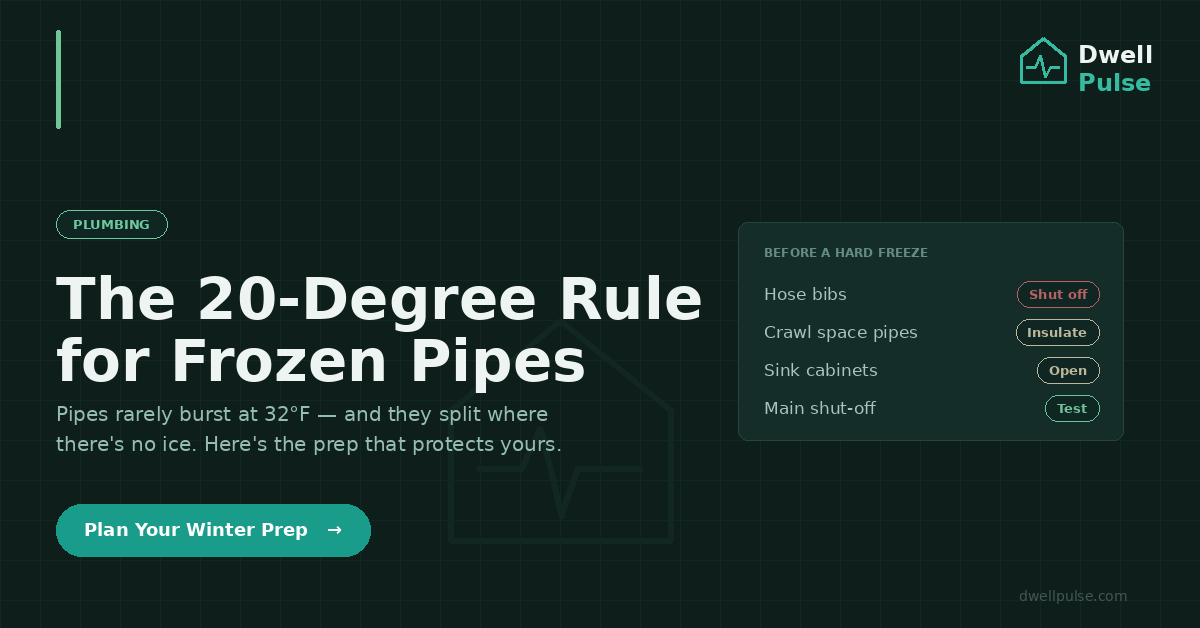
- Disconnect, drain and store your hoses. Close the indoor valve that feeds each outdoor hose bib, open the bib to drain it, and add an insulated cover [4]. If a bib has no indoor shut-off, have a plumber add one [3].
- Drain sprinkler and pool supply lines following the manufacturer’s or installer’s instructions. Don’t put antifreeze in them — it’s harmful to people, pets, wildlife and landscaping [4].
- Insulate exposed pipes in crawl spaces, attics and garages. Foam pipe sleeves from the hardware store are the easy win. For the worst runs, use UL-listed heat cable with a built-in thermostat [3][4].
- Seal the cracks and openings near your pipes — foundation gaps, rim joist gaps, and wall penetrations. Caulk handles small gaps; expanding foam handles bigger ones [3]. (If you’re already sealing drafts for your heating bill, these are the same leaks.)
- Find and test your main water shut-off. If a pipe bursts, this is the valve that decides whether you’re mopping up a gallon or a room. If you’ve never actually turned yours, here’s how to check it before you need it.
On Nights Headed Toward 20°F
When the forecast low gets close to the alert threshold:
- Drip the faucets served by at-risk pipes. If the faucet has both hot and cold lines running through a cold space, drip both [3].
- Open the cabinet doors under kitchen and bathroom sinks so room heat can reach the pipes [3][4].
- Keep the thermostat steady day and night. Skip the overnight setback during a cold snap — a slightly higher heating bill is much cheaper than a burst pipe [4].
- Keep the garage door closed if any water lines run through the garage [4].
Heading Out for the Holidays
If you’re traveling for Thanksgiving or the holidays, frozen pipes in an empty house can run unnoticed for days. Before you leave [2][4]:
- Leave the heat on, set no lower than 55°F, and leave the sink cabinet doors open.
- Heat pump homes: if extreme cold is forecast while you’re gone, you may need to switch to emergency heat so the house holds temperature [4].
- Consider shutting off the main for a longer trip — but know that if your home has fire sprinklers, that shuts them off too [2].
- Ask someone to check the house if a cold snap hits while you’re away.
If a Pipe Freezes
The tell is a faucet that gives you a trickle or nothing at all [4]. Then:
- Leave the faucet open. As the ice melts, moving water helps melt the rest [4].
- Apply gentle heat with a hair dryer, heating pad, space heater or hot towels, starting near the faucet and working toward the frozen section [2][4]. Keep cords and appliances away from any standing water [2][4].
- Never use an open flame — no torch, propane or kerosene heater, or charcoal stove. They’re a fire hazard and a carbon monoxide hazard [4].
- Keep going until full water pressure comes back, then check every other faucet in the house. One frozen pipe often means there’s another [4].
- Call a licensed plumber if you can’t find the frozen spot, can’t reach it, or can’t get it to thaw [4].
If it has already burst: shut off the main water valve, leave the faucets open, and call a plumber [2]. Then photograph the damage and call your insurer. A pipe that bursts from freezing is generally treated as sudden and accidental damage, which standard homeowners policies usually cover — but your policy may expect certain preventive steps, like keeping the house heated [5]. Read your policy before you leave a house empty in January.
Write Down What You Learn
Every house has one or two pipes that are always the problem — the kitchen line on the north wall, the run over the crawl space vent. You find out which ones they are the hard way, once. The point is to not find out a second time.
So keep a record: which pipes froze and when, what you insulated or sealed, which bibs got covers, when the plumber added that shut-off and what it cost. Next November, that’s your checklist. If you ever have to file a claim, it’s evidence you took care of the house. And when you sell, “we insulated the crawl space lines in 2026 and haven’t had a freeze since” is exactly the kind of answer a buyer’s inspector wants to hear.
How DwellPulse Helps
DwellPulse turns this from something you remember on the first cold night into something that’s already handled. Add your winter plumbing prep as recurring fall tasks — hose bibs, sprinkler lines, pipe insulation checks — so they come up before the cold does. Because DwellPulse follows the National Weather Service forecast for your property, severe cold alerts can turn into prep tasks for your home, so you hear about the hard freeze before the first 20-degree night. And when you log the work — the sleeves, the heat cable, the plumber’s invoice — it becomes part of your home’s permanent history, ready for next winter, an insurance claim, or the day you hand the keys to a buyer.
See how DwellPulse plans your seasonal maintenance →
Sources: [1] This Old House, “Water Damage Statistics,” citing the Insurance Information Institute’s 2025 report: water damage and freezing made up 22.6% of home insurance claims (2023 data), with about 1 in 67 insured homes filing such a claim each year and an average claim of $15,400 (2019–2023). [2] Carrier Management, “Frozen Pipes Lead to $628M in Losses for State Farm,” January 27, 2026, citing State Farm claims data: more than 20,000 frozen-pipe claims from January 2024 through June 2025, over $628 million paid, an average claim exceeding $30,000, top states Illinois, Oregon, Washington, Texas and Tennessee; plus State Farm’s prevention and thawing guidance, including the note that shutting off water disables fire sprinklers. [3] Institute for Business & Home Safety, “Freezing and Bursting Pipes,” summarizing field research by the University of Illinois Building Research Council: the 20°F temperature alert threshold, the survey of 71 southern plumbers, the role of wind and air leaks, why pipes burst downstream of the ice blockage, dripping faucets to relieve pressure, and recommended insulation and sealing. [4] Texas A&M AgriLife Extension, “Winter Storms: Preventing and Thawing Frozen Pipes,” adapted from American Red Cross and IBHS guidance: prevention steps, the 55°F minimum when away, the heat pump emergency-heat note, and safe thawing methods. [5] Progressive, “Does home insurance cover water damage?” on burst pipes from freezing generally being covered as sudden and accidental damage, and on preventive measures a policy may require.
* This article was written with the assistance of AI tools. All content is reviewed and edited by Josh Standeven.
Related guides
Ready to take control of your home?
DwellPulse is free to start — track maintenance, projects, appliances, and your garden all in one place.
Start Free Today →